Today, I want to delve into a topic that many of us may encounter along our path to an active and fulfilling lifestyle: injuries. As we pursue our passions, such as climbing, distance running, or mountain biking, it’s not uncommon to face setbacks due to injury. In this blog post, we will explore the transformative power of accepting injuries with patience and even gratitude, embracing them as opportunities for growth.
The Lesson of Patience: Injuries can be frustrating, forcing us to put our aspirations on hold and disrupting the momentum we have built. However, they also provide us with a valuable lesson in patience. By accepting and respecting our body’s need for rest and recovery, we develop patience as we wait for the healing process to run its course. Patience allows us to shift our focus from immediate progress to long-term well-being, nurturing a deeper understanding of ourselves and our bodies.
The Gift of Self-Reflection: During the healing process, we have an opportunity for self-reflection. Injuries force us to slow down, providing an opportunity to reevaluate our goals, motivations, and approaches. We can use this time to delve into our mental and emotional well-being, examining any imbalances or areas of improvement. Through self-reflection, we gain a deeper understanding of our limits, strengths, and the underlying reasons behind our pursuits.
Gratitude for What We Have: Injuries can be a stark reminder of the blessings we often take for granted. When we are unable to participate in our favorite activities, we realize just how much joy and fulfillment they bring to our lives. By practicing gratitude for the abilities we possess and the progress we have made, we cultivate a mindset of appreciation. Gratitude fuels our motivation to recover and return stronger, inspiring us to make the most of every opportunity once we regain our strength.
Exploring Alternative Paths: Injuries can lead us to explore new avenues that we may not have considered before. While we may be temporarily sidelined from our primary activity, we can embrace this opportunity to discover other forms of exercise or engage in activities that nurture different aspects of our well-being. Exploring alternative paths allows us to broaden our horizons and discover hidden passions or talents, enriching our overall experience.
Cultivating Resilience: Perhaps the most significant gift that injuries bestow upon us is the chance to cultivate resilience. When faced with obstacles and setbacks, we have an opportunity to strengthen our mental and emotional fortitude. By adopting a positive mindset, focusing on the lessons learned, and persevering through the challenges, we emerge from injuries with newfound resilience and a greater capacity to face future hurdles.
As we navigate the realm of injuries, let us embrace them with patience and gratitude. They are not roadblocks but rather detours that redirect our journey toward self-discovery, growth, and resilience. By accepting injuries as part of our active lifestyle, we open ourselves to transformative experiences and emerge stronger, both physically and mentally.
This year, I’ve set some non-running goals for myself. It’s a good thing too. Because of some silly over-training on my part, I’ve come down with posterior tibial tendonitis (PTT). PTT is much less frequently experienced by runners than the dreaded plantar fasciitis, which I’ve also had, but PTT has proven to be just as pesky to get rid of. After 6 weeks of physical therapy, I’m still unable to run any distance pain free. I have learned over the years that in order to maintain my mental stability in a demanding workplace, I need to move. I’ve also learned that I do better when I’m moving outside. Last year in the summer, my cousin, her husband and I hiked to the top of Mount Chocorua and it helped to fuel a whole new fire in my belly.
I have some lofty climbing goals for the year. My cousin’s husband invited me to join his three-person group to summit Mont Blanc later in the year. At 4,810 m (15,781 ft), this isn’t exactly a walk in the park. While my fitness should not (at least before my self-inflicted injury) be an issue, it would be good to get more experienced on trails and in wintery conditions since the top of Mont Blanc is glacial ice year round. So, we have planned a couple of tune-up climbs. This coming weekend, we will – weather permitting – climb Mt. Washington in New Hampshire. While the altitude is not stunning at 1,916 m (6,288 ft), the climb is fairly technical and the weather can get downright treacherous. Some 150 people have died on Mt. Washington since record keeping began in the mid-1800s. As such, I’ve been taking a multi-faceted approach to training.
Getting Vertical
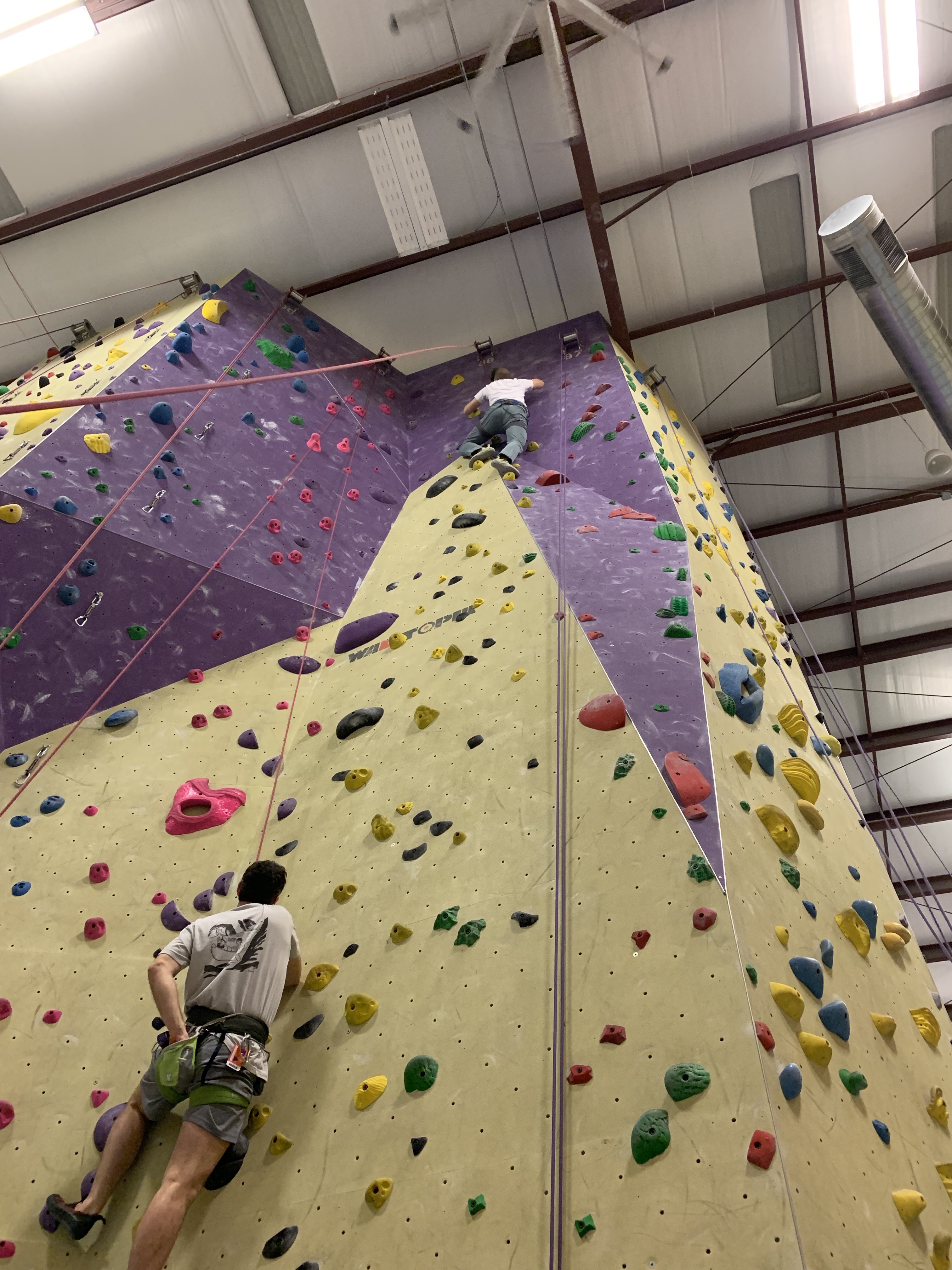
That’s me up in the purple zone. And yes, for you experts, it is an easy course.
Growing up in the foothills of the Appalachians, I’m no stranger to hills. I’ve even done a bit of ill-advised, inexperienced bouldering (rope-free rock climbing) in my youth. But on the whole I have very little experience going vertical. So, I’ve recently been going rock wall climbing at a local gym in town. We are very lucky to live in a metropolitan area with these kinds of options, since the tallest natural peak around me can be measured in the tens of feet. I’m finding that I love climbing. Much like running, it gives me a sense of accomplishment. While I’ll do it when I have to, I sincerely detest machine or free weight training for the sake of weight training. It just does not leave me feeling accomplished. Climbing on the other hand has everything I’m looking for: problem-solving, a great muscle work out, and some elements of cardiovascular exercise as well. I’m sure a seasoned climber would tell you that my technique is terrible, but still, I’m pretty reliably going upward and building in confidence. Even better, my wife agreed to join me on my last trip and it appears that this might be something we can do together. While I don’t intend to do any actual vertical climbing on Mt. Washington or Mont Blanc, getting experience well help me remain confident and sure-footed as we take to steep ascents on higher terrain.
Equipment Test
I learned this year that Mountaineering is chocked full of equipment. Extra stiff mountaineering boots, crampons, trekking poles, lightweight layered clothing, eye protection, and on and on. The acquisition of this long list of surprisingly expensive equipment has turned me into bit of a bargain shopper, as I’ve learned the ins and outs of various websites and specialty stores. Now with a tub full of equipment, I figured it was important to get out and try out some of the gear, as the first time I wear this stuff should not be on the mountain. So, I recently packed up and headed out on my local running trail for a 10k hike while completely over-equipped. I’m sure I was a real sight as I strode around a trail essentially designed for running while dutifully using my trekking poles and carrying a pack replete with ice axe. At least it was a little snowy that day so I didn’t completely look like I was off my meds. Here’s what I learned:
Super-stiff mountaineering boots are great for keeping your Posterior Tibial Tendon relaxed. These things are not too dissimilar to a medical immobility boot
Super-stiff mountaineering boots are, on the other hand, not great for my outer most toes during long-range hikes on mostly flat ground. Mine were both quite red and quite angry at the end.
Trekking poles are surprisingly helpful, especially when precariously balancing on rocks while crossing a stream in sub-freezing temps
There are many sharp points on an ice axe that, if not carefully positioned on your backpack, will in fact poke you repeatedly
Super-stiff mountaineering boots are also not excellent on ice in spite of what appears to be quite aggressive treads on bottom
Strength Training
I know what I said earlier about strength training, but I’m actually happy to weight train if there is a purpose. As I watched YouTube videos about climbing Mount Washington in the winter, I came realize that I’m in for quite a workout. And since I’m not able to run any sort of distance at the moment, I knew I would need to hit the weights. So, three to four days a week I’ve been working the major muscle groups. Squats, deadlifts, bench press, dips and pull ups have become my friends again along with a bunch of core exercises. For years now, I’ve been running at least an hour a day roughly 6 days a week. It hasn’t left a lot of time for weight training. As one might imagine, I have lost a fair amount of strength and muscle mass. But here’s the other thing I forgot. Weight training makes me ravenous. So now I’m gobbling vast quantities of food that I haven’t needed or wanted and my… ahem… waistline is suffering a bit. I’m resisting pulling the fat pants out of the closet, but I know from experience that I’m getting dangerously close to opening an embarrassing stitch line with one ill-timed stoop to pick something up off the ground. Let’s just hope I can keep my pants in one continuous piece until I can get back to running.
Sense of Purpose… and Impending Death
On the whole, I’ve thoroughly enjoyed the shift in focus from running as I learn new mountaineering skills. It has given me a sense of purpose in my free time since I’m unable to log the running miles that I’ve grown accustomed to. I still have so much to learn, from knot-tying to belaying, to not having an ice axe come loose and stab me in the face. Yes, that last little number was a tidbit I picked up from reviewing the manual for my recently acquired ice axe harness. Apparently, mountaineering is a bit of a medieval sport.
This is absolutely part of the instructions that came with my recently acquired ice axe leash




 Quixote Goes