Ulysses: Scylla and Charybdis

Happy Bloomsday, dear readers!

Today, we embark on an exploration of another captivating chapter in James Joyce’s Ulysses: “Scylla and Charybdis.” Just as Odysseus faced the treacherous sea monsters in Greek mythology, our beloved protagonist, Leopold Bloom, finds himself in a literary whirlwind of ideas and discourse.

  1. The Mythical Undercurrent: Scylla and Charybdis, in Greek mythology, were two perilous creatures situated on opposite sides of a narrow strait. Sailors passing through had to navigate between the two, avoiding the fatal consequences of each. In Ulysses, this mythical reference sets the stage for an episode filled with intellectual challenges, debates, and conflicting perspectives.
  2. A Collision of Minds: Similar to the turbulent waters Odysseus encountered, “Scylla and Charybdis” immerses us in a flurry of literary discussions. Bloom finds himself amidst a gathering of intellectual minds, including Stephen Daedalus, the elder Daedalus, Myles Crawford, and others. These characters represent various viewpoints and engage in intellectual sparring, providing a rich tapestry of contrasting ideas.
  3. Bloom’s Outsider Status: In this chapter, we witness Bloom’s continued role as the outsider. While his peers passionately debate literature and politics, Bloom remains on the periphery, struggling to fully engage in the intellectual discourse. Yet, it is precisely his position as an observer that grants us a unique perspective, allowing us to witness the clash of ideas and ideologies from a different vantage point.
  4. Themes Echoing Through the Chaos: Within the chaos of discussions, several overarching themes emerge:
    • Intellectual Inferiority: Bloom often finds himself regarded as intellectually inferior by his peers. Despite his efforts to contribute and connect with others, he is met with condescension or mockery. This recurring theme highlights the insecurities and societal dynamics that shape our interactions.
    • The Power of Language: Language takes center stage as the characters engage in linguistic acrobatics. Joyce masterfully weaves wordplay, allusions, and references throughout the chapter, emphasizing the transformative power of language and its ability to shape ideas and perceptions.
    • National Identity and Politics: The discussion of Irish home rule and English influence permeates the discourse. As with much of Ulysses, the tension between Irish identity and the influence of colonial powers adds depth to the narrative, reflecting the societal and political context of early 20th-century Dublin.
  5. Finding Meaning Amidst the Whirlwind: “Scylla and Charybdis” may be a challenging chapter to navigate, but it offers a profound exploration of intellectual pursuits, the complexities of human interaction, and the power of language to shape our understanding of the world. As readers, we are encouraged to embrace the chaos, to delve deeper into the layers of meaning, and to appreciate the intricate web of ideas woven by Joyce.

In closing, “Scylla and Charybdis” invites us to embrace the tumultuous currents of intellectual discourse, reminding us that within the whirlwind of conflicting viewpoints, there lies the potential for profound growth and understanding. Like Odysseus navigating treacherous waters, Bloom’s journey through this chapter serves as a testament to the human capacity for resilience, curiosity, and the pursuit of knowledge.

Wishing you the happiest of Bloomsdays!

Boldly going, occasionally delusional.

-Troy
Haiku You

There are several forms of poetry that I truly enjoy. I don’t know where this comes from, as I essentially have no history with poetry. But, I think if you’re following my blog, we can agree that “eclectic” is a nice, agreeable term for my personality. So it probably comes as no surprise that I love the Haiku. I mean, what’s not to love? There are three lines with specific syllabic requirements; and the first two lines agree while the third line is juxtaposed against the first two. It is a challenge begging to be mastered.

The Assignment

Not long ago, I dreamed up this idea that I thought would be fun. Thankfully, I have a team at work that is willing to entertain my whims. Otherwise, I’d just be this weird dude with weird ideas that didn’t work out. So, I dreamed up this idea. What if we (my team) all took a couple of weeks and wrote our own personal Haiku? My team members got to choose how it represented them – whether it was past, present, or future. At about the midpoint of the assignment, we pondered whether or not our lives would fit into 17 syllables. So we decided to add a wrinkle. Everyone should send their Haiku poems to me. I would compile them and read them aloud while everyone else on the team voted on the author.

The Results

While I won’t type them all, my team did fantastic. Some of them were very specific and others were more metaphorical, but all of them represented their author in some specific way. I’ll lead off with mine. Not because its the best, but because I can most readily explain the story behind it. Here goes:

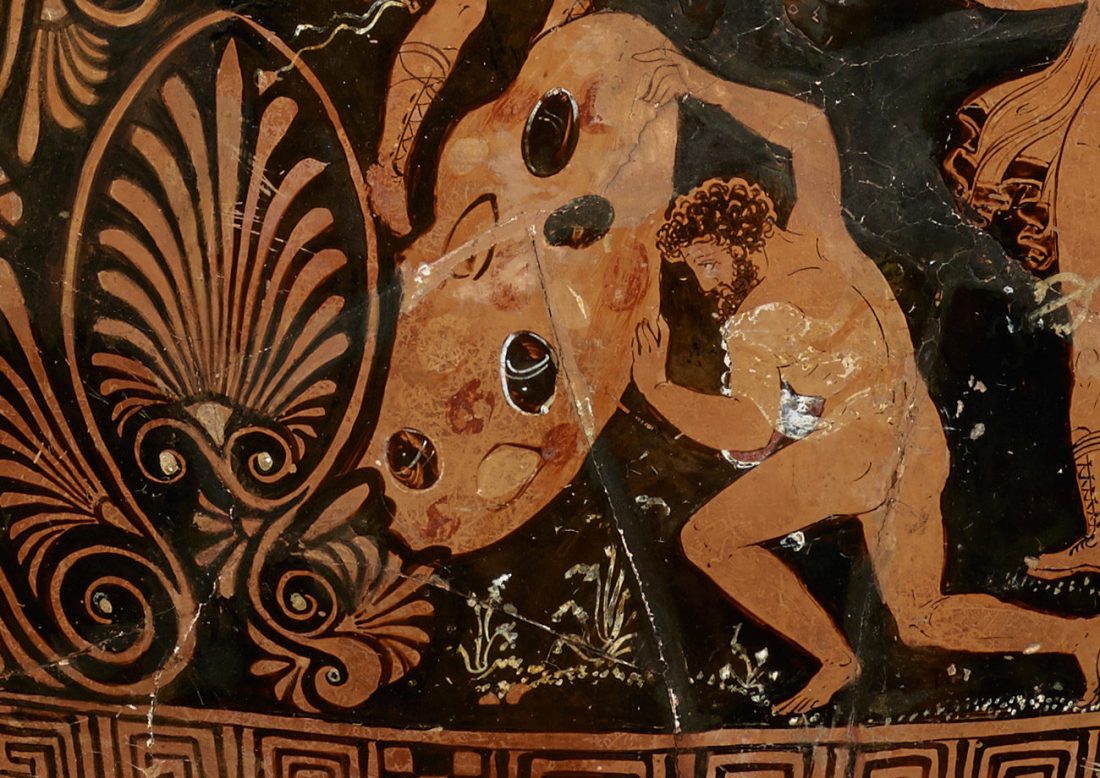
Roll the rock up, up
Roll it today and always
Everything changes

Those of you familiar with Greek mythology will already recognize the reference to Sisyphus. For those unfamiliar, Sisyphus was a world class smart aleck. In life, he outsmarted both man and god alike. So in his afterlife, his eternal task was to roll a boulder up a hill only to watch it roll back down. Personally, I struggle with futility and anything that is circular. If there is a definition of hell for me, it would be to suffer the fate of Sisyphus. But alas, I identify with him as well. I readily recognize the folly in the mundane, everyday tasks that constitute my day-in, day-out routine; and yet at work I dutifully go about my tasks as if I had the short term memory of a gold fish.

As for the third line, it essentially means that over time, things do change although they often border on the imperceptible. It wasn’t until I accepted my mundane tasks and the duty with which I execute them that I recognized that change does happen. One day, I’m plugging away rolling the rock up the hill with a sense of duty and all of a sudden, it becomes trendy to roll the rock up the hill. The next thing I know, I’ve got a following. People want to know how they can roll their rocks up their hills as fast and as far as I do.

As a forty-something, I also identify with the book / movie Fight Club. I think this was the most pointed reference I had to identifying a Power or Spirit Animal. Since Fight Club, I have often joked that my spirit animal is a dung beetle (Seriously, check my Twitter feed). It doesn’t take a genius to associate Sisyphus and dung beetles, so I’ll leave it to you dear reader to pull it all together. Plus, I was in an office setting, so its much safer to talk about rocks and boulders than it is to talk about dung. I digress.

Here are a couple of other notable Haiku poems from my team – without all the Greek mythology / Discovery Channel references.

Rough notes on a page
Melodies sad and hopeful
Heart sings with laughter

Music in my head
The wind and trees surround me
Living wild and free

And perhaps my personal favorite:

What comes after this?
Another year has gone by
Oh great, more traffic

In the end, my team loved this activity. They enjoyed the chance to be creative in an otherwise standard corporate office setting. We also enjoyed the guesswork of deciding who wrote what. What I find most interesting is that if we did it again in a few weeks time, the Haikus would be different. There is something very “here and now” about this activity. Which leads me to my closing questions:

What is your Haiku?

If you were to restrict “who you are” to the very short requirements of the Haiku, what would they be right here, right now?

I’d love to read yours.