What Bad Habits Would You Like to Stop?

I’m blessed to have a great team at work who entertains my introverted need to connect on a more-than-small-talk level. I’ve explained in a previous post that my work team has “huddles” to bring each other up to speed on our work and that Friday’s are dedicated to a philosophical discussion prompt. This Friday’s prompt was: “What bad habits would you like to stop?”

Open the kimono

There’s a vulnerability with this prompt and I didn’t want anyone to be uncomfortable. So I kicked us off with a bad habit that I would very much like to cut out. Since my last marathon in December, I decided to take a short break from running and working out. I was burnt out. After taking a three week break, I have struggled since January to get back into any groove. It has essentially become a bad habit for me to sabotage my own routine. I explained to my team that after a few days in a row of the behavior I want, I’d come home from work and procrastinate getting changed for my run because of “paying the bills” or some other thing that could be done later. This would effectively destroy my 3 or 5 day streak and then disrupt the whole process of getting back into a fitness routine. I have had some success with using the scorecard I wrote about in a recent post, but I don’t consider myself out of the woods just yet.

Having “opened my own kimono,” my team felt more at ease with sharing. As we progressed around the table one person even said, “I’m so relieved to hear that I’m not the only one who struggles like this.” I’ve put the team members’ intentions in the following numbered list. Note that these are college educated professionals who range in age from 24 to 60+ and have their lives together. Here’s how it went around the table. Obviously, I’ve left out names.

  1. I want to crowd out (more on this later) things that I want to stop with reading more books.
  2. I need to stop procrastinating cleaning out my garage. I haven’t been able to park my car in there for years.
  3. I want to stop wasting time on my phone. I can lose up to an hour in the morning before work and up to an hour before bed. Some of the practices are good – like I’m working on foreign language skills, but some of it is just flat out, unproductive scrolling.
  4. I want to stop looking forward so much. While looking forward has helped me achieve a lot of goals, I find it hard to just live in the moment and appreciate what I have.
  5. I want to stop trying to form new habits “cold turkey.” Late last year, I tried to cut out caffeine and go vegan at the same time. I lasted four days. I think I was hallucinating.
  6. I want to stop wearing myself out at work so that I have no energy for family time. I sit on the couch and get lost in TV or something and then realize hours have gone by and I’ve missed out on time with my preschool daughter.
  7. I have made strides in this area over the years, but I find that I still get pulled in trying to help people who don’t want to help themselves.
  8. I want to do a better job of finishing off personal projects. I get excited about things and go full on for the first 90% and then I just can’t seem to get to the finish line with the last 10%.

Crowding out the bad with the good

Assuming you’re at least marginally interested in habits if you’ve read this far, there are a couple of concepts I’d like to highlight. First, the first Team Member shared the idea of crowding out undesirable behaviors with desirable behaviors. This is all the rage in wellness habits. Nutritionists are now routinely telling their clients to crowd out processed or deep fried foods and red meat with more fresh vegetables and fruits. It works because of positive psychology. We funny monkeys (thanks Nick Offerman) respond better to the affirmative “eat more of this” than we do the restrictive “cut out that.”

In this case, Team Member 1 wants to crowd out time lost going down internet rabbit holes with more time reading books – a noble endeavor indeed. This crowding out concept would also help Team Member 5 who has seen the abrupt “cold turkey” method fall flat, as well as Team Member 3 who wants to reduce wasted screen time. Speaking of screen time, I recently decided to delete a vacuous app that was sucking me into the never-ending scroll. I didn’t delete my account so I still get notified if someone connects directly with me, but the web browser version is much less satisfying than the app. So, I’ve crowded out senseless scrolling with book time.

Be in the present

The second concept is being present. I’m absolutely fascinated by Buddhism. The more I learn about it, the more I am blown away that these 2,500 year old concepts align so completely with modern psychology. For a deeper dig into this space, check out Robert Wright’s book, Why Buddhism is True. Team Member 4 mentioned a desire to enjoy the present in lieu of always looking to what’s next. This concept of being present is very much a part of Buddhist tradition. As His Holiness the Dalia Lama has been quoted, “There are only two days in the year that nothing can be done. One is called Yesterday and the other is called Tomorrow. Today is the right day to Love, Believe, Do and mostly Live.” Team Member 4 is almost 15 years younger than me, so in my book, he’s well ahead of the wellness game by recognizing this habit.

As I started down the path of my mindfulness journey a couple of years ago, I became aware of how much time I was mentally spending not in the present. I describe it this like this: Most of my mental time was either ruminating over past losses or in anxious anticipation of future losses. I don’t think that Team Member 4 is in loss mode like I was. I think he’s more in planning mode to achieve his next goal. But it can be equally detrimental to look forward to “one day.” As one achieves goal after goal, he or she often finds that the destination wasn’t quite as sweet as anticipated. Then what? The trick I’ve learned is to start on a mindfulness path and try to achieve quiet satisfaction with right now. If you’re interested, I highly recommend subscribing to Leo Babauta’s Zen Habits for a simple, free and unbelievably rich resource.

A nerd and his team

I’m a self-proclaimed wellness habit nerd so I had a blast with this conversation. I have somewhat expected these Friday philosophical discussions to become trite after a couple of months. But they haven’t. In my 40+ years, this is the first time I have found a group of people who keeps striving for self-development for any length of time. Every Friday, I count my lucky stars that I get to work with this amazing group of like-minded individuals.

Looking back on 42

42. That is the answer to the Ultimate Question of Life, the Universe, and Everything. At least according to Deep Thought, the supercomputer in Douglas Adams’ seminal work, The Hitchhiker’s Guide to the Galaxy, it is. Those who have read The Hitchhiker’s Guide… will already be snickering with this reminder. Those who have not, should. Having recently completed my 42nd trip around the sun on this tiny blue planet, I’ve decided to have a look back on my Ultimate Year.

  • It was my first full year without my Dad. He died in 2016, and looking back, his death has had a huge impact on me. Most notably, the circumstances of his death had a profound influence on my mindfulness practice.
  • A year of seniors. My son is now a senior in college, my daughter a senior in high school. My, how time flies.
  • I ran my first marathon. And my second, and my third, and my fourth. I can be obsessive.
  • My first full year of eating a plant-based diet. Inspired by Scott Jurek and Rich Roll, I’ve got better health numbers now than I did in most of my 20’s and all of my 30’s.
  • It was a good year for my career too. I want to keep my career separate from this blog, but it was a good year following a promotion to a leadership position. I have a fantastic team full of amazing individuals. I wouldn’t trade a single one.
  • My mindfulness practice tipped – in a good way. I read several insightful books this past year, but two of the best were The Power of Now by Eckart Tolle and Siddhartha by Hermann Hesse. Gaining insights and simply fumbling my way through it, I have taken control of my emotions and want for almost nothing. I would by no means call myself enlightened, but it is a fascinating state of being.
  • I supportted my wife as she pursues her passion: a Master’s of Psychology from Harvard University.
  • I fell in love with trail running. Previously, I had only pounded the pavement. In my 42nd year, I ran several trail races locally and, perhaps most life-altering, I got the chance to run the petit balcon in the French Alps near Chamonix. This is where I took the lead picture of this post.
  • I was able to go whale watching. Surprisingly, this was the highlight of our trip to the Massachusetts beach house in Marshfield. I expected to like seeing whales. I didn’t expect to be mystified.
  • We finally took the trip to Montserrat. After years of traveling to Barcelona and always thinking about it, we finally took the day trip to Montserrat. The monastery houses the Black Madonna and my Mom was speechless. The views from the mountain are stunning.

As I wrap up this short post, I find myself in a state of complete gratitude. My wife and I both hail from small towns (I’m not even sure “town” is the right word for these places) in the Appalachian Ohio Valley, home of economic backwaters and the opioid crisis. Sometimes we look at each other and just shake our heads in awe of what the Universe has provided. The views at 42 were pretty grand.

The view from the Marshfield, MA beach house:

Whale Watching on Cape Cod

James and me (right) in Chamonix before heading up into the Alps

My homemade veggie paella

Looking down from Montserrat

Running Routine: Using a Scorecard to Get Back on Track

My dog is a very good dog. He’s loving, smart, obedient, careful with his 60 lbs size, and almost never makes a mistake. Today, he went out for his morning routine and found something new in the yard that was extremely smellyand then he rolled in it. The last time he did this a couple of years ago, it was a young bird that had fallen out of the nest and died. Now that he’s done this, I need to try to find the offending matter, remove it from the yard and then give him a bath so he doesn’t spread the stinky, mystery “juice” all around the house. This event now takes up the time that I had allotted to fix a healthy meal and then head out in my running gear for an already tight schedule. Oh Rusty, what have you gotten into?

Rusty post-bath
Rusty post-bath

The last several weeks have been a lot like this; our car was rear-ended by a person who has a complicated insurance situation, my wife had to have an unplanned surgery, add in a choir concert, a birthday, an awards ceremony, friends dropping in from out of town, and so on. In addition to disrupting my running schedule, I’ve also been eating “fast food,” opting for veggie burgers and fries instead of well balanced, whole food meals. My pants are tight, I’m grumpy, and I am out of my running routine. In less than 30 days, I need to run three legs of a 150 mile, 24 hour race. I’m the captain of the team so there’s no backing out. I’m not that far out of shape, and I can get there. But I honestly need some mechanism to help me get and stay on the path.

Self-Licensing

Why would a person who ran four marathons last year need a mechanism to get back on track? Moral Self-Licensing. Daniel Effron and his colleagues define this concept as follows: “past good deeds can liberate individuals to engage in behaviors that are immoral, unethical, or otherwise problematic, behaviors that they would otherwise avoid for fear of feeling or appearing immoral.” Of course, my issues are not so much moral or ethical in nature, but they certainly are problematic.

There’s a sort of mental accounting going on here. For example, we got rear-ended through no fault of ours. The guy who hit us gave us a bogus insurance card. Without getting into too many details, he has a pseudo-company car and is insured by someone else. So we’re taking extra time to track it all down so we can get our car fixed without legal escalations. We’re doing all the right things, being professional, jumping through the various hoops, but it is taxing. So in effect, I’ve been giving myself “credit” for doing the right thing in these other areas and then opting for a glass of wine instead of heading out into the cold for a training run. I recognized this Self-Licensing behavior a few days ago and realized that I needed to make a change.

Developing the Scorecard

If you can’t measure it, you can’t improve it. – Peter Drucker

I have used this principle countless times in business and in my personal life. In this case I knew that, at a minimum, I needed to get on track with my running. But there’s a balance here too. Run too much at the expense of other things and the wheels fall off. The obvious companion to running is my diet; I’ve got to cut back on the processed foods. I have also learned that I need to spend at least a little time on mediation as well as some creative outlet to help me feel balanced. So I developed a quick scorecard using Apple’s Numbers application that I can access from almost any device.

Designing the metrics takes a little thought too. I have done scorecards in the past where I simply assigned myself a 5 point rating, where 5 = “well done” and 1 = “ugh”. DANGER: Self-Licensing can come into play here too. For instance, I might assess my day thinking about all the toil and trouble I had and then give myself a bonus point because, really how much salt can be in that veggie burger and fries, anyway? Answer: A LOT, so I need to count it correctly. So I got specific. On first glance, the categories below might seem tedious. Well… I AM a Process Engineer, so I’ve timed it. It takes me no more than 5 minutes to complete the scorecard daily. Here are my scorecard categories I’m using for the 30 days’ preparation going into my team running event:

  • Diet: I eat a plant-based diet, so I’m simply breaking food into two categories: either came directly from a plant (raw spinach) or it was factory processed prior to me eating it (burrito shell). (e.g. 11 whole plant foods out of 20 total foods on the day = 55%)
  • Exercise: Expressed as a percentage of 60 minutes of activity that raises my heart rate (e.g. 30 min = 30/60 = 50%)
  • Meditation: Expressed as a percentage of 10 minutes of meditation (e.g. 7 min = 7/10 = 70%)
  • Gratitude: Expressed as a percentage of writing down 3 things that I’m grateful for (e.g. 2 items = 2/3 = 67%)
  • Creativity: Expressed as a percentage of 20 minutes of creativity: writing, photography, drawing, painting
  • The Feels: 5 point Likert scale where 5 is Amaze-balls, 3 is Meh, and 1 is the inside of a used Trash bag. I’ll use this to track how I’m feeling over each of the 30 days.
  • Notes: Very brief (10 words or less) observations or things I might want to work on tomorrow.

So… How’s it going?

Date Diet Exercise Meditation Gratitude Creativity The Feels Notes

Mar 14

55%

101%

170%

100%

200%

4

I felt great getting started with this!

Mar 15

50%

150%

120%

0%

0%

3

I had a good workout but feeling meh

Mar 16

42%

75%

150%

100%

0%

4

Too much processed food; but date night!

Mar 17

50%

113%

0%

100%

200%

4

Happy St. Patrick’s Day!

I have run 4 days in a row and I’m feeling quite good about it! I can tell that I’m already bridging some of my fitness gaps while maintaining a good balance with the rest of my healthy habits. Even though I’m only holding myself accountable through a digital scorecard, it has completely given me the motivation I needed. I don’t like entering zeroes.

How about the other stuff?

We’re chipping away at it all. My wife has turned the corner from her surgery and is back on her feet. I took my lunch hour on Friday and made several important calls. I have also observed that now that I’m getting back into a fitness routine, my mood is lifting and so sitting down to figure out “life’s current challenges,” is actually getting easier.

Vacation is Over: A Mindfulness Opportunity

To do list

As I write this, I’m fighting off the feeling of being overwhelmed. My wife and I came back from an exciting trip to Ireland and rejoined life at full pace. What a great opportunity to put my mindfulness practice to good use! Here’s a quick idea of the irons we have in the fire:

  • My wife is going to have an unplanned surgery today and she’ll need my help getting to and from the medical center and help getting around at home
  • Like her, I have my normal full time job where I need to dig out of my inbox and keep my projects going
  • I also have a special work project that’s due in 30 days, where I’m coordinating the activities of 20+ people and we will deliver our content to more than 100 people around the globe –  oh, and we’re not as far along as I’d planned
  • I am captaining a 10-person running team that will run 150 miles over 24 hours; race day is 30 days away and I need to replace two injured runners with a surprisingly administrative process to do so
  • Our daughter is being honored at a special school conference event for her outstanding achievements
  • Our oldest son is celebrating a birthday
  • Our car needs repaired because we were rear-ended the day after coming back from vacation
  • Our car also needs its routine maintenance, which is done by a different business than the one that will repair the damaged bumper
  • We need to get back into routine with normal household duties: cleaning, grocery shopping, cooking healthy food, laundry, and driving the younger kids to their after-school activities

I could go on, but I don’t want to be a bore. I also want to be clear, I’m not complaining. My wife and I consider ourselves very lucky to have four happy and healthy kids and to lead busy, fulfilling lives. But at this juncture, I’m feeling very much at full capacity. As I go through this list, I can feel the pressure in my chest. I notice that my breathing is shallow and I’m feeling “on alert.” With each new email that comes in, I’m scanning it for the next fire drill as I try to dig out of this hefty pile. Historically speaking, in times like this I would be tense with other people as well. People might stop by and ask about my vacation or ask me about the special project I’m leading, and it’s difficult to not be short with them. But that doesn’t really get me anywhere – especially when I need to work with other people to accomplish these goals.

An Opportunity to Practice Mindfulness

I’ve been studying this process for about two years. I have pulled from multiple sources, but my favorite is Zen Habits. While I think Leo Babauta does a masterful job of explaining his process, I’m going to use my own words to describe my personal experience and the process that I’ve learned.

Step 1: Sit with the discomfort*. I described how I was feeling above. I noticed that I was breathing in a shallow fashion. I noticed that I was feeling anxious and on alert for “what’s next.” In years past, I might look for a distraction. Maybe I’d grab my phone and scroll through social media or get a salty snack – anything to make me feel immediately better while not really addressing the discomfort of the long and urgent to do list. Or maybe in the case I’ve described above, old Troy would break into action; choosing one very simple thing from the list and dive right in. In this case, I’m looking for the satisfaction of completing anything. I might decide to take out the trash and run the dishwasher. Important? Meh. Urgent? Not compared to what else is on the list. Again, this jump-into-action is a form of turning away from the discomfort. 

Step 2: Breathe. This is really more like step 1.a. Finding my breath is the way to sit with the discomfort. This is going to sound silly, but I really like this metaphor. Taking deep breaths allows me to disconnect from the discomfort and examine it with detachment. I envision being able to reach into the pit of my stomach where the discomfort is stirring, remove it, and then look at it in my hand. Now in my hand, I can examine it like a child does a feather or an earthworm for the first time. Being able to mentally detach from the feeling and view it with childlike curiosity allows me to see this discomfort with perspective. This little thing is not the end of the world. In fact, it’s the opposite of the end of the world. It’s an opportunity to practice overcoming discomfort. But first, it needs a name!

Step 3: Name the discomfort. I’ve somewhat completed this one with the list above. Honestly, this takes practice. In years past, I might resist this step and just be irritable and quiet. I tended to go into a “problem-solving cave,” where I would shut out other people and roll up my sleeves to slog through the work in front of me. This often had the effect of introducing additional stress because my loved ones, who care deeply about me, would want to know what’s going on and how they can help. Already tense, I might give a short answer about being overwhelmed, which would eventually lead to a longer conversation and – most likely – an argument. By taking a few minutes to name or list the issue(s), it will help me disarm its hold over me. Then I’m free to move on to resolving it.

Step 4: Resolve it. In this case, I’ve got a lot of work in front of me. But I’ve broken through the discomfort and I’ve accepted the situation for what it is. Now that I have the list, I can…

  1. Rationalize the list – assess whether I need to do this right now or push it out until I have more time,
  2. Communicate what is in front of me to my loved ones so they can understand my stress,
  3. Identify where others can lend a helping hand (if possible), and
  4. Ask for help

I find that after completing this process, I’m in a much better mental state to accept the next curve ball that might be thrown my way. Another way of saying that last sentence is that my Emotional Intelligence has gotten a boost. And in the ever-changing and fast paced world that we live in, I can scarcely think of a more valuable skill.


Do you have a mindfulness practice? Do you have a different process or a different take on what I’ve described above? I’d love to hear from you! Leave a comment below or email me directly at quixotegoes@gmail.com.


*NOTE: I am using “discomfort” in an emotional sense. If you are having medical discomfort, please seek the help of a medical professional.

Reflections of Ireland Part 4: Bloomsday in March

I know I’ve mentioned it in other posts, but I’ll say it again. I am a huge fan of James Joyce. With this year’s major trip going to Ireland, there was simply no way I was going to miss out on having a Joyce / Ulysses experience. Readers of James Joyce will know that June 16, aka Bloomsday, is THE big day for fanatics. For the less initiated, Joyce’s book, Ulysses takes place over the course of this single day in the city of Dublin. I couldn’t be in Dublin in June, so I celebrated my own Bloomsday on Sunday, March 5. While doing my trip research, I was delighted to find not only a James Joyce Centre but also a Ulysses Walking Tour. I have taken several walking tours in the past and they feature in some of my fondest travel memories. After getting my private walking tour set up with David Halpin, Owner and Guide of Dublin Ulysses Tours, my day was set. I was ready to geek out.

The Centre

Before the walking tour, I decided to visit the James Joyce Centre. I’m glad I experienced the Centre before the walking tour. While I want to support the Centre in its efforts to preserve and promote the works of James Joyce, it honestly left a bit to be desired. There are three floors to the Center and the unguided tour is started by climbing the stairs to the top floor to experience the museum on the way back down. The top floor has an interesting Ulysses publication “family tree,” which traces the various Ulysses editions relative to their publishing houses and publication dates. There is also a video that plays three short documentaries about Ulysses. On the second floor, there are several painted portraits from the Joyce family as well as visual schema of each of the chapters of Ulysses. The ground floor has the gift store and a viewing parlor with John Huston’s movie, The Dead playing, but the display lacked any indication as to how it tied to Joyce. So… the James Joyce Centre was good but not great. At €5 per person, I think it’s priced right for the value delivered. If you go, plan for about 1 hour max. The short documentaries on the top floor, which I haven’t found to be available on the internet, take just over a half an hour to watch in total. The rest of the museum will take no more than 30 minutes to walk through.

The Walk

Having wrapped up the time at the museum, it was time for the main event. David and I had arranged via email to meet at The Palace Bar on Fleet Street in the Temple Bar neighborhood. We recognized each other fairly quickly and settled into a back corner over pints of Guiness. Note that David provides customized, personal tours and he’s constantly looking to improve, so if you go (and I highly recommend it regardless of your experience level with Joyce / Ulysses), your experience will likely differ from mine.

The Palace Bar is a time capsule with wood paneled walls, a hardwood bar and a friendly curate to match. While there is a single mounted TV, it was turned off. This is no sports bar. The Palace is an old fashioned pub meant for talking and to add to the ambiance, its walls are adorned with pictures and portraits of the writers and artists who have frequented it over the years. The seats are comfortable and we were free to arrange them as we pleased. The bar was about half full and the other patrons paid us no mind as David pulled out his hefty copy of Ulysses to call out specific quotes and points. During our chat, David and I discussed our own stories and how we came to experience this tremendous author and his seminal work. David is a polite conversationalist and he really takes his time to make a connection. We chatted for nearly an hour. Then we packed up and headed out into the early spring Dublin weather for Bloom-style walk around Dublin.

Immediately outside, David pointed out the gold colored memorials built into the sidewalk commemorating four of the Irish writers who frequented The Palace. He explained their connection to literature and to Joyce. At this point, I had been in and out of The Palace twice and hadn’t seen these gold colored plaques. As I would soon discover, I had been walking over similar commemorative sidewalk features for the previous several days.

After leaving The Palace, David took us down backstreets pointing out Dublin street art dedicated to Irish literature. We stopped by the statues outside of Oliver St. John Gogarty’s Bar and viewed the murals on Bloom’s Hotel.

From there, we walked out to College Green and headed toward Trinity College Dublin. David is full of insights about the roles the characters and buildings played in literary history. I wouldn’t do it justice, so you’ll just have to take the tour. From here, we turned right onto Grafton Street and picked up the trail of Ulysses fictional protagonist, Leopold Bloom. This was my third time to Grafton Street in as many days because it is the main shopping district; however, like those plaques outside The Palace Bar, it was my first time seeing the gold colored Bloom plaques embedded in the pavement. Pictures of three of the plaques follow.

These plaques mark the walk of the fictional Bloom as he traveled the very accurately portrayed streets of Dublin during the course of the day and night of June 16, 1904. Experienced readers will already know from the pictures above that the plaques quote passages from Ulysses at the time in the book when Bloom was at that real life juncture. Off of Grafton, we turned left onto Duke Street, which is where I learned not only that Davy Byrnes still exists in a modern state, but also that there is a Ulysses Rare Book Store. I would later visit the store and purchase one of several vintage copies of Ulysses available for sale. For vintage book lovers, this place is worth the trip just to get a glimpse of the Ulysses first edition that is stored under glass behind the counter. But there are plenty of more accessible vintage books by a wide variety of authors on the shelves that the average wallet can afford.

We then followed Bloom’s footsteps over to the National Library, where David brought Bloom and his arch rival, Blazes Boylan, to life with a quick reading of the corresponding parts of Ulysses. From here, we traveled to a neighborhood hotel for a quick stop and a view of what is perhaps the least known – and by far the best rendering I have seen – memorial to Joyce and Ulysses. David’s narrative perfectly illustrated the quoted text as we made our way around the 360 degree monument. Given that this piece isn’t yet called out on Joyce sight-seeing website lists, I’ll keep this spot concealed and again refer the reader to David’s Dublin Ulysses Tour to catch a glimpse.

From here, we made our way to Sweny’s pharmacy, which is where Bloom fictionally picked up the lemon soap for his wife Molly. Sweny’s is no longer a working pharmacy, IMG_2558but is rather a standing homage to Joyce and societal home to – these are my words – a loose knit group of local Joyce volunteers who are committed to keeping the sights and sounds of his work alive. Inside, David introduced me the volunteer in chief, PJ, who shook my hand and inquired about my surname. After providing him with my four nearest related family names, PJ rattled off a brief and authoritative geographical history of my 4 bloodlines. After that, he sat down and sang me a song in Irish as he strummed along on guitar. And with that act, I’m pretty sure I joined this Joyce “society” in whatever form it exists. My tour with David had concluded, but my evening was far from over.
The Reading

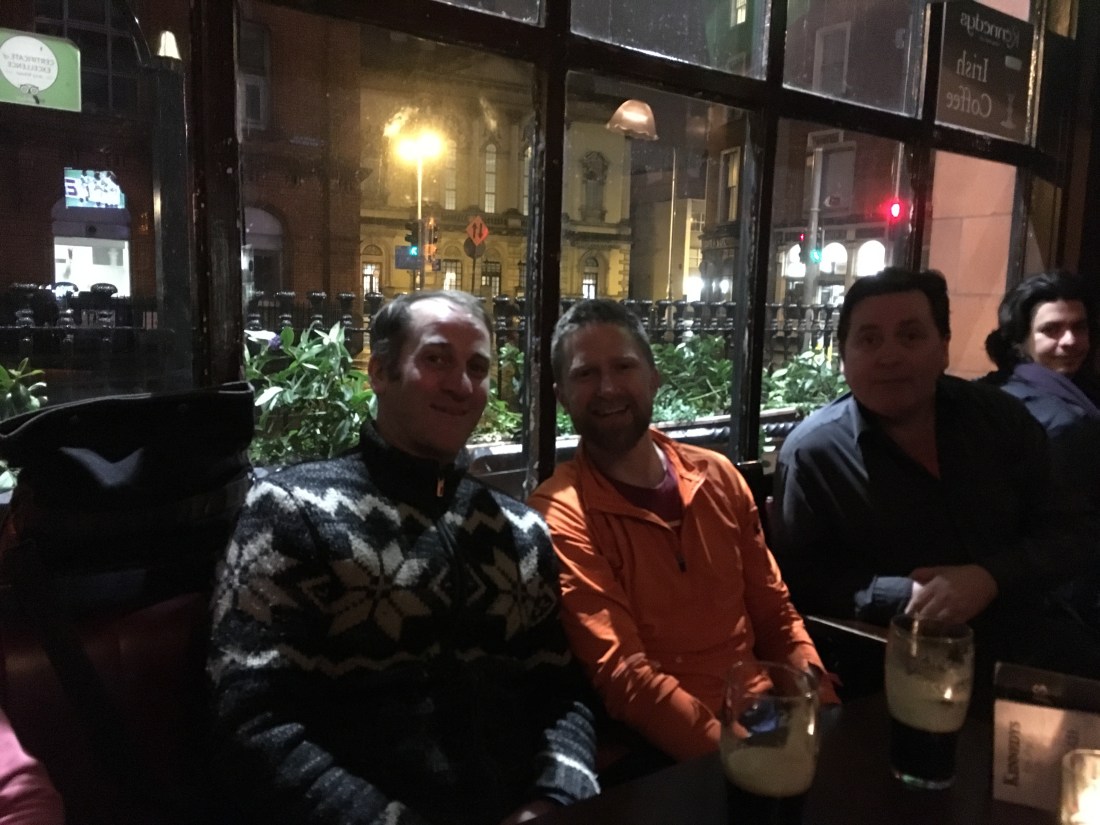
There was almost no question as to whether I was coming along with David to “the reading” after my whirlwind initiation. PJ just looked at me and said, “We’ve had to move the reading across the street to Kennedy’s because we have a good sized group. This is good because we’ll have some pints as we read. Grab a book and let’s go.” So, I did.

“The reading” as the name would suggest, is a group of people sitting around the table each with the same book in hand and each taking his or her turn to read a page. The book was Joyce’s Finnegans Wake, which I had never read.

IMG_2559
David Halpin, me, and other “readers”

What I did know about the book is that it took Joyce 18 years to write and that the language was almost entirely Joyce’s own amalgamation of various languages around the world. It has a reputation for being nearly unreadable. There was no time for me to be intimidated. About 4 minutes after I sat down and caught the place in the book, it was my turn to read. It is said of Joyce’s work that one of the best ways to access it is to simply read it aloud. I’m sure I got most of it wrong. Others sounded more authoritative in their readings. However, I’m sure that the pints of Guiness that were flowing helped all of us “just go with it.” With one loop round the table of 9 readers, I settled into the process and had a great time. After several loops and a few pints, PJ signaled that it was time to wrap up the reading and he gathered up the books to take back across to Sweny’s.

As the books closed, the discussions opened. I formally met most everyone around the table and we quickly leapt into topics large and small: gun laws in America; US Presidents Trump, Obama, and a sprinkling of Bill Clinton; Irish social classes and Dublin neighborhood distribution relative to the River Liffey; the movie Pulp Fiction, and on and on. Unfortunately, I had to wrap up the evening and get back to my family. As I made my rounds and said my goodbyes, it was a bittersweet moment. I had immediately connected with a Joycian tribe and after a few delightful hours, it was time to go.

Finding Joyce’s Dublin

Through his works and his correspondences, we know that Joyce was fiercely committed to the human experience. After all, what landed Ulysses on the banned book list in all English speaking countries as soon as it was published is the fact that it is an odyssey of the human body and mind. Joyce wrote about things that – at the time – just couldn’t be written about. My day up until that point had been committed to knowing more of Joyce and the Dublin of his time. I was focused on facts and figures. But as I reflected on the day during my long walk along the Liffey back to my Airbnb, I began to realize that my evening at Kennedy’s Bar, connecting with David, PJ and others who share a common interest as we discussed the politics and issues of our day, was as much taking part in Joyce’s Dublin as anything I have done. This is Dublin City. Constantly renewing while celebrating its rich history. Today’s Dublin is Joyce’s Dublin. To experience it, one needs to find a pub, grab a pint, and start a conversation.

Reflections of Ireland Part 3: The Day Dublin Stood Still

Friday, March 2, 2018. If I were to believe the headlines and talking heads on the news, this day was supposed to be filled with danger as the “killer storm” Emma which gave way to #thebeastfromtheeast settled in on Ireland. And yet somehow, we’ve made it alive. Dublin is our third and final leg of our cross-country tour of Ireland. We had significant plans to see various sights and do a bit of shopping. But… Mother Nature has thrown us a snowball. The snow was predicted to be as deep as 10 inches (25 cm) in Dublin City. By my estimates, we’re right around 4 inches total over 2 days of snowing. For a country that gets roughly 2 inches of snow per year, it is a lot. They’re not equipped with snow plows and such, so they do a little grit-spreading and hope for the best.

Closed for Business, but Open for Craic

All major tourist attractions were closed, as were all public transit systems. Essentially all businesses were closed and very few taxis were operating. This vibrant, mischievous city eerily rolled up its sidewalks for a bit of snow. However, the residents of Dublin were not to be deterred. Being from Ohio, where we get plenty of weather of all types, I happily went out in the weather several times and I encountered loads of people. In fact, at the height of the storm on Friday morning, I set off on a run from Sarsfield Quay (pronounced “key”) along the River Liffey and out to the ocean via Irishtown. The round trip run was 10 miles and took me a little longer because I had to check Google Maps from time to time. Travel Tip: When traveling to a city outside your home country, I highly recommend downloading offline maps of your destination. It will allow you to see where you are and navigate streets without using data. Its a handy replacement to using a physical map. I want to be clear here: when I say “navigate” I’m not saying that it will give you turn by turn directions like navigation, but it does allow you to see your “dot” on the street and you can zoom in on your location to see street names and notable locations. Every time I ventured out, I found people walking their dogs, searching for open grocery stores, or having a bit of craic (Irish term loosely meaning “fun;” pronounced “crack”). I came across people building snow men and several “gangs” of teenage boys itching for a snowball fight.

Snowballs Thrown

I was hit with several snowballs during my travels in the city. I took it for what it was – boys having fun. I noticed that only men who appeared fit enough to defend themselves were targeted, so this wasn’t a situation where kids were out being bullies. As I made my way in the streets, I would catch a glimpse of someone making a snowball and turning away. It was a sure sign that one was coming my way. A couple of times, they’d miss and I’d talk a little trash about their poor marksmanship. Usually, they rose to the challenge and fired a few more my way. Only once was I hit in a malicious way. I was walking past an older teen with grocery bags in both of my hands. I noticed the snowball in his hand and made a mental note that I’d brace for the throw about 15 paces after we pass one another. It didn’t take so long. Right after he passed me, he smashed the snowball into the back of my head. For a second, I considered dropping my bags and retaliating. But I’m sure that’s what he wanted, so I just kept walking without giving him the satisfaction. Not everyone took the same turn-the-other-cheek approach that I did.

Things Heat up in the Cold

On two occasions, I saw the snowball situation escalate. On one occasion several boys pelted a van with snowballs. The driver stopped, words were exchanged, but not much more came of it. On another occasion, a boy threw a snowball over a car – to be clear, it didn’t even hit the car – and the driver pulled over. This was in the midst of “The Beast” and the driver hopped out in only a t-shirt and jeans. He was itching for a fight. Muscle bound and shaved head with a chain connecting his wallet, he got out and gestured at the boys. I couldn’t hear the words, but he clearly wanted a fight. The boys – there must have been 8-10 of them – all stayed out of arms reach and I thought that it was over. Nope. The man made a “That’s what I thought” gesture and started to turn around to get back into his car. And that’s when they hit him with three snowballs at the same time. I was laughing out loud, incredulous. I live in a de-escalated world where this simply doesn’t happen. Furious, the man rounded on the boys and took a few steps in the direction of the snowballs. The boys scattered, but it only lasted a few steps. When the man dind’t get hold of anyone they turned back around and fired off more. I kept thinking that this is going to end in fisticuffs if someone doesn’t layoff. That’s when the girlfriend got out of the car.

Apparently muscle man had a significant other in the vehicle and she was tired of seeing her man pelted with snowballs while not one of the snowball-hurling kids being willing to physically fight him. So she jumps out of the car and into the street while making wild hand gestures and – although I only wish I could hear her – yelling madly at the group of kids. She’s egging them on to either fight her or to hit her with a snowball, which thankfully no one does. I assume at this point if she gets hit with a snowball, muscle man is going to run someone down with his car. This Mexican standoff continues down the road in front of the Guinness factory, and then well beyond our ability to see it with the car moving about 20 yards at a time. Here’s what I know: I didn’t read about it in the papers the following day and I didn’t see a snowball fight-related murder on the news. So I can only assume it all ended peacefully enough.

Slow Down and Have a Laugh

In the end, I think this incident was a perfect microcosm of Dublin. It’s a vibrant city full of young adult things to do but it lacks a bit of maturity. Yes, there is an incredibly rich literary history, but if you look into those authors, few of them were above a bawdy joke or a long night of hard drinking. And that’s just fine by me. I know that I’m certainly guilty of taking myself too seriously from time to time and this mischievous city with its public shutdown and wild snowball fights is just the reminder I needed to sit back, have a drink, and enjoy the ride.

– Sláinte!

Reflections of Ireland Part 2: On the Road to Tralee

If you’d like to connect with a people and their culture, spend a couple of days in the hospital. I know, I know, that sentence didn’t end the way you were thinking. Our trip hasn’t exactly gone the way we thought it would either. On the second half of our bus tour of the Ring of Kerry, my wife started getting sick. By the time I got her back to our Airbnb in Killarney, she was literally green and feverish. After she had a nap and overcame her fever, we consulted WebMD and discovered her symptoms checked all the boxes for an appendicitis. Having never experienced a health problem away from the US, we called her insurance company for some direction. The response was swift and admirably simple: go to the hospital and save your receipts for reimbursement.

On the Road to Tralee

Our stay is in Killarney, which is a lovely little town of about 14,000 residents and no hospital. The closest hospital is about 30 minutes drive into a neighboring town of Tralee. We consulted our Airbnb hosts and they confirmed that Kerry General Hospital in Tralee is the place where they go if needed. So, we packed up and headed out. I was raised in the US so driving a sizable right-side drive, manual transmission vehicle on the left side of the road is a bit disorienting. Luckily, I’ve had a few days practice so I was able to deal with the added stress of driving my wife to the hospital at night on roads I hadn’t seen. However, I’ll readily admit that my knuckles were white from time to time over the half hour drive. Over the next 36 hours, I would make this drive in both directions several times as I made provisional trips to and from the hospital. Travel Tip: Planning to drive in Ireland? On top of allowing yourself some time to orient to the left side of the road before jumping into city traffic, I HIGHLY recommend paying the extra fee for the GPS. It took the guess work out of reading road signs (written in Irish first, English second), navigating countless roundabouts, and helped me keep track of the not-always-noticeable speed limit signs.

Irish Healthcare

In hindsight, I’d have looked up the information before traveling to know what to expect. What I learned in our exhaustive time in waiting room of the Emergency Department is that Irish Healthcare is among the slowest in Europe. My wife was seen promptly for admissions and was seen by the triage nurse within 35 minutes. After a very short interview, she informed us that it would be a 4-5 hour wait before we could see the doctor. It was closer to 6 hours. Having arrived at the hospital at roughly 9 PM, we were able to see the doctor at 2:45 AM. Other than taking blood and urine samples and a basic interview of symptoms, no diagnostic work was done until the next morning. At least she had a bed. After sitting in the aluminum bleachers in the waiting area for hours on end, getting a bit of rest in a hospital gurney helped her feel a little more comfortable. I spent the early morning in minimally padded chair next to her and only nodded off briefly once or twice. Over her 36 hour stay, she had an ultrasound, a CT scan, and several consultations with knowledgeable and caring nurses and doctors. The amenities left a little more to be desired.

Other than during her initial consultation with the doctor, she spent the entire time on a gurney in the hallway because the hospital was over-full, which we’re told is quite routine. I promptly lost my chair when she moved into the hallway and either had to go sit in a waiting room away from her or stand in the hallway near her bed. Perhaps the most frustrating part of the visit was the delivery relative to commitments. For instance, after learning that her ultrasound did not help with the diagnosis at 10 AM, we were told she would have a CT scan by 3 PM. She actually received a CT scan at 5:30 PM and was later told that only emergency CT scans are read after 5. That was when we realized that she’d be spending another night in the hallway. Thankfully she didn’t require surgery and was released the next morning with prescriptions. In the end, I would rate the care received as very good, the amenities as less-than-adequate, and the wait times to be longer than average. Travel Tip: If you need hospital care in Ireland, Americans can expect quality care comparable to what we receive in the US but with significant wait times.

The Human Connection

Spending 36 hours in a hallway gurney along with other patients and their families provides significant opportunities to connect with people. We met, among others, a 12 year old girl who broke both wrists in an elliptical bike accident, an elderly lady who was denied an oxygen tank because she hadn’t demonstrated that she had “given up the fags” (stopped smoking), a retirement-aged mother who personally thanked me for the existence of Bon Jovi, and a nurse who wondered what we thought about President Trump. We also got the chance to sit quietly for a bit and listen to conversations among locals. There is a wonderful, polite rhythm to the Irish conversation. It might go something like this (the reader will have to insert the Irish lilt):

  • Man 1: Alright John?
  • Man 2: Never better. You and the missus?
  • Man 1: Nary a complaint
  • Man 2: Where’s that no good partner of yours?
  • Man 1: Did ye check the canteens and pubs?
  • Man 2: I ‘spect he’ll be shutting ’em down later
  • Man 1: Dontcha know
  • Man 2: Alright, gotta get on with it
  • Man 1: Good luck to ye
  • Man 2: T’anks a million, take care

I mentioned in my last post that Ireland and her people reminded me of my childhood home in Southern Ohio. Never was this more apparent than in the hospital. The spoken and body language communicates so much with so little. There is a wonderful wit and wisdom communicated with a sense of humility in these little exchanges. Briefly, one can let the another know that he feels for him and that “we’re in this together.” My wife and I discussed this at length. We believe this comes with the homogeneity of culture that permeates much of rural Ireland. Because of their shared culture and vernacular, they’re “hyper-communicating,” which is my term for sending paragraphs of dialogue in verbal and non-verbal shorthand. And while our accents are different, this brand of communication is very much a part of Southern Ohio’s Scotch-Irish culture. In fact, we even share several colloquialisms. To illustrate, I was giving one of the nurses a hard time and she didn’t respond, feigning frustration. My wife told her to not take me seriously and I said, “Ah, she knows I’m only just funnin’.” This prompted an almost immediate reply from a third party nurse: “Where did you say you’re from again? Because you’re clearly Irish.”

Welcome Home

I wouldn’t wish an appendicitis on anyone. My wife experienced intense pain and I’m sure she was “this close” to having an appendectomy while in the middle of our vacation. However, the experience – without question – gave us a chance to better connect with our host country. And when you boil it all down, that human connection, that rediscovery of the common thread that binds us all together, is essentially why we travel. In the waiting room, as we were chatting with the mom and her little girl with the broken wrists, an elderly lady overheard us and asked if we were American. We said that we were. She smiled from ear to ear, looked at each one of us and said, “I’m sorry for your trouble, but welcome home.”

Reflections of Ireland (Part 1)

Ireland has been on my bucket list for quite some time. Like many in the US, and like most people from the town in which I hail, I have more than a little Irish heritage. I’ve always wanted to go to Ireland and have a look around. My favorite author, James Joyce, is also famously Irish. Walking around Dublin and seeing the sights of Joyce’s epic Ulysses has been of dream of mine for several years too. Our trip plan is to start in Galway and see the Cliffs of Moher. Then we’ll travel to Killarney and tour – among other things – the Ring of Kerry. Having checked the box on beautiful countryside, we’ll move on to Dublin for several days. I’m a few days into the tour and I wanted to pause for a few reflections.

Ireland feels like home

I’m originally from Southern Ohio. Think, “foothills of the Appalachian Mountains along the banks of the Ohio River.” My part of Ohio is dominated by Scotch-Irish culture that has had time to ferment in a small town environment for a few hundred years since our ancestors predominantly migrated from Ireland. Our people are a heavily accented, slow-paced, kindly folk who are fiercely independent and suspicious of “outsiders” who might be selling solutions to problems that they likely don’t understand. The Southern Ohio landscape is dominated by lovely rolling green pastures, forested hills and plentiful natural water sources that support farming and outdoor activities such as hunting and fishing. I honestly can’t say I was surprised to find a very similar land, culture, and people. Admittedly, I haven’t made it to Dublin yet, but what I have experienced feels like my rural Ohio roots. What I have been struck by is the amazing beauty of the Emerald Isle.

Did I mention that Ireland is Amazingly Beautiful?

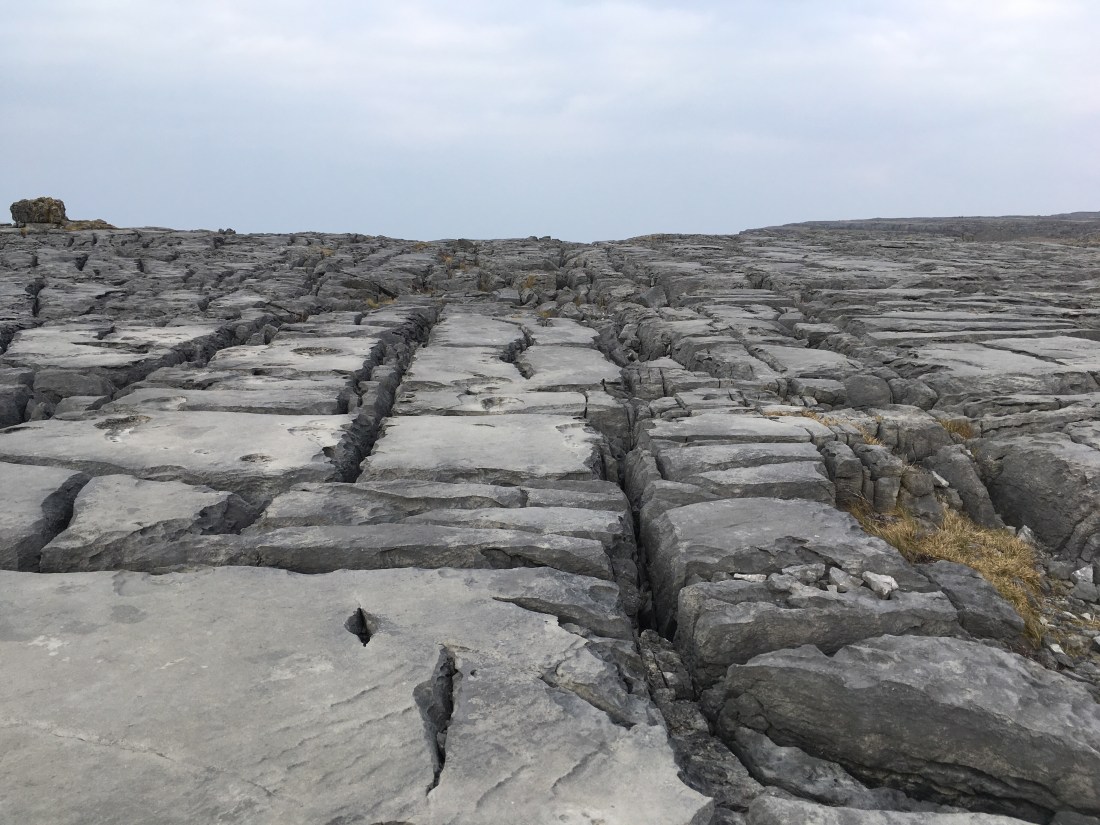
So far, I have driven from Dublin to Galway, taken the Cliffs of Moher tour, driven from Galway to Limerick with a brief stop for lunch and a tour or King John’s Castle, and then on again from Limerick to Killarney. The sights are absolutely a.maz.ing. In just a couple of days, we’ve been able to see (pictured in order) 1. The River Corrib in Galway, 2. The Cliffs of Moher, 3. The rocky coast of the The Burren, 4. King John’s Castle in Limerick, and 5. Muckross Lake in Killarney. I am absolutely enamored with the beauty of this country – and, while Southern Ohio cannot totally compete – the sights are at least reminiscent.

The River Corrib in GalwayThe River Corrib in Galway

The Cliffs of MoherThe Cliffs of Moher

The rocky coast of The Burren

View of the River Shannon from atop King John’s Castle

Sunset over Muckross Lake

Until next time… Sláinte chugat!

Five Benefits from Five Years of Journaling

I first started journaling when I was going through a divorce several years ago. The stresses of separating from my spouse, figuring out finances, and helping the children adjust all while maintaining my focus at work was getting to me. I almost started journaling on a whim. I’m a bit of an introvert and I’m not prone to sharing details with others. So journaling was my way out; my way to organize my thoughts and to “say” the things that I didn’t want to actually verbalize to anyone else. I wrote somewhere around 200 pages over 18 months. When my divorce was complete, I purged the file and later started a new one. My second journal turned 5 years old two weeks ago. I’ve decided to start a new one. The file size was getting unwieldy and five years seems like a good cutover point. Starting anew, I reflected on the journaling process and realized how much I’ve learned from it. While there’s probably more, here are my top five benefits from five years of journaling.

1.) Problem solving

I solve problems for a living. Of course, I could argue that everyone who has a job is essentially being paid to solve problems that customers aren’t willing or able to do themselves. But problem-solving is my specialty. I have an engineering background, several technical certifications, and 20+ years of experience solving fairly sizable problems across various industries. With these credentials, one might think that I could solve just about any problem in my sleep. That would be wrong. While it certainly is my forte, sometimes I get stuck. I find that journaling is my unlocking mechanism. The free form of journaling helps me describe a problem from multiple angles or to refine what it is and what it isn’t. I find that spending time writing about a problem not only helps me find breakthrough solutions, but it also stops the swirling in my head. I also use it for household problem-solving. For instance, there was a particularly nasty head and chest cold going through our house from season to season and journaling about it over time helped me figure out how to 1.) avoid getting it and 2.) speed the recovery time from more than 3 weeks to about 5 days. 

2.) Procrastination buster

I’m not one for procrastinating. I’ve always been internally motivated, so when I recognize that something needs to be done, I generally get going. Therefore when I am actually procrastinating on something, I know it’s a special cause. I might not like what needs to be done and I might be waiting on a better solution. Or, it might be that I have too much to do and – if I’m honest – I’m too busy feeling sorry for myself that I won’t pick a direction and move. Bring on journaling! Writing about these situations helps me to be honest with myself about my lack of movement. It really might be that I’m overwhelmed. I’ve often heard the quote, “Sometimes when you don’t know what to do, the best thing to do is nothing.” (Unknown attribution) I wouldn’t say that I do nothing. But I certainly have learned that sitting down to the keyboard, which was no where on the list of things to do, helps me prioritize the work in front of me. When I’m procrastinating out of a sense of being overwhelmed, journaling is exactly what I need. If I’m just hung up on the task at hand or feeling sorry for myself, sometimes I go ahead and have a good complaint session. I write down all the crap that’s annoying me at the time. The act of reading it after I’ve written it helps me see how petty I’m being. Recognizing my pettiness then causes me to shift into gratitude for everything that’s great in my life. And gratitude is extremely motivating. The point is that while I don’t procrastinate often, it can be caused by a number of different factors, and writing helps me get to the bottom of it and get moving.

3.) Better communicator

Have I mentioned that I’m an introvert? One of the key characteristics of an introvert is that we have far, far more thoughts than what comes out of our mouths. A lot of times, I’m just not ready to speak. I might have 4 thoughts on the same topic and if I start speaking without organizing them, I’ll probably confuse myself, never mind the poor listener. Journaling helps me get my thoughts out of my swirling mind. When a topic is particularly complex, the only way to sort it out is to pick up the journal and simply start writing. I may write in circles – making the same point repeatedly with only slightly different angles. But writing it down helps me sort out my thoughts so that I can communicate in a cogent manner. 

4.) Emotional Intelligence

Emotional intelligence is the ability to recognize and exercise control over your emotions, which in turn helps you connect with others. Journaling has helped me in strides on this front by following a simple guide that I learned in college. I took a course on Personal Transformation, which was amazing. Among other techniques, I learned to break down interpretations of an event. I’ll use an example to illustrate. Let’s say I’m running late to work and on the commute, someone cuts me off in traffic. My brain might jump to a conclusion like, “She cut me off just to be a jerk because she could see I’m in a hurry.” In this class, we learned to separate what happened from our interpretations. What actually happened? A lady merged into traffic in front of me, maybe cutting it a little too close given local standards for traffic spacing. When I interpreted what happened, I assigned meaning to the event. She meant harm. She meant to do what she did to prove a point. When I journal about this event, I might rant and rave about it for a few sentences, but then I use the “what happened and what did I interpret” method to break it down. After journaling, I might realize that I created the tight space with my rushed driving. She might have thought she had ample time to pull into traffic had I been going with the flow of normal traffic. Or, maybe she was also in a hurry because she was on the way to the hospital to spend time with an ill child. I really can’t know what was going on with her and I may have had some input in the event. Over time, this practice has become like a muscle that I flex through journaling so that I’m able to process faster in real time, thus giving me more Emotional Intelligence.

5.) Mindfulness Step 1

I didn’t realize it, but when I started journaling on and off about 8 years ago during my divorce, I took my first steps toward a path of mindfulness. dictionary.com defines mindfulness as “a mental state achieved by focusing one’s awareness on the present moment, while calmly acknowledging and accepting one’s feelings, thoughts, and bodily sensations, used as a therapeutic technique.” I originally started journaling to sort out my thoughts and feelings during my divorce. I needed to address my concerns about the kids and money and the car and the laundry and the bills and the… you get the point. Through journaling, I was able to feel like I was doing something about my concerns. I could write them out to their logical conclusion and see that things would somehow be okay. I was learning to be present. It was a form of meditation for me. Having logged 300 pages in the last five years, I can easily say that journaling was a HUGE first step in my mindfulness journey. 

Getting Started

If these five benefits sound pretty awesome, there’s not really too much to getting started. You might start with a pen and paper. I personally use Pages on Apple products and simply password protect the file to help ensure that it doesn’t get opened or edited by others with whom I share devices. You can do the same with Google Docs and Microsoft products. Whatever you do, stick with it. You might not see the benefits on your first entry, but over time you’ll have your own top five list of benefits.


Traveling with a Parent

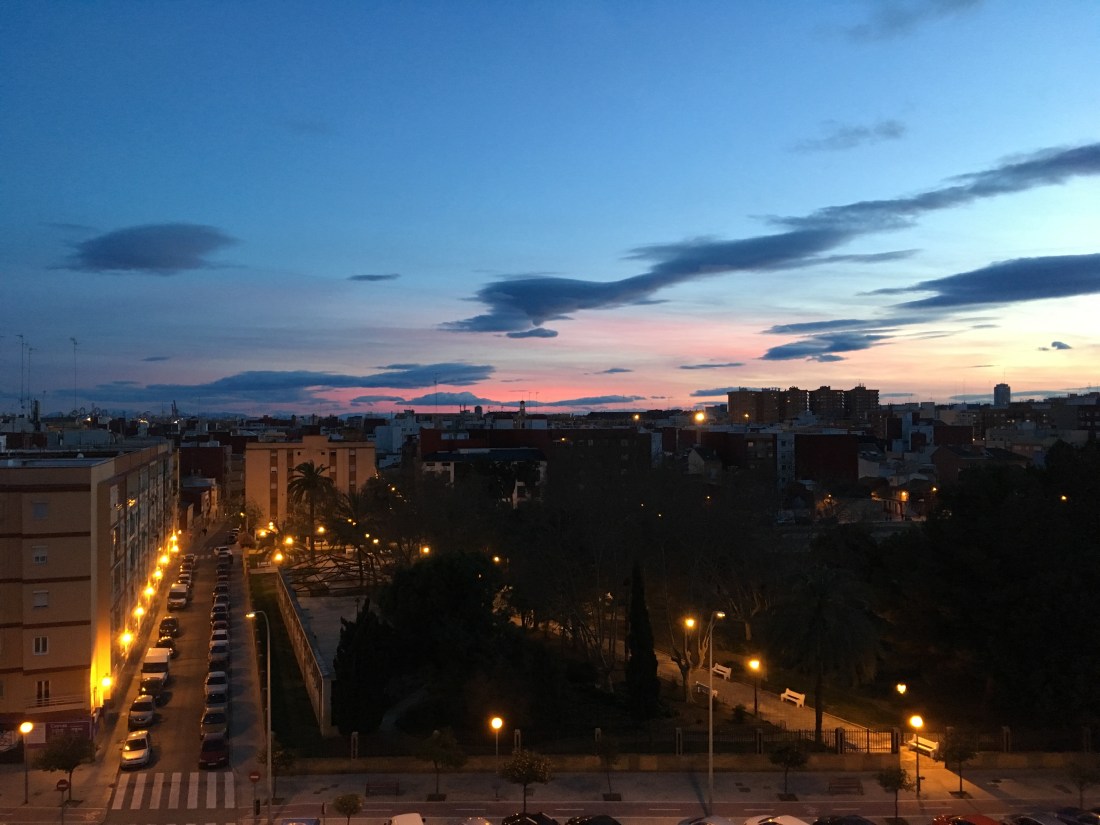
Sunset over Valencia

Traveling can be a great way to share fun and exciting experiences with a parent by following a few simple rules.

The Backstory

I must get my adventurous spirit from my mother. She had always wanted to travel with Dad, but his declining health after retirement made it impossible. Sadly, he passed away about 18 months ago. After allowing herself ample time to grieve his passing and after getting things settled, I’m grateful that she accepted my invitation to go to Spain. So about 8 months ago, my wife and I took Mom to our adopted home away from home, Barcelona and added on a brief stay in Valencia. While in Spain during a casual conversation at dinner, Mom listed off her dream travel destinations: England, Scotland, Ireland, Australia, and New Zealand. I lovingly pointed out that all of her dream destinations have the English language in common, to which she replied, “Oh, I didn’t even think about it, but I guess that’s true!” Oh Mom, I love you. Anyway, I got the message loud and clear. This year we’re headed to Ireland.

Planning the Trip

There were definitely some lessons learned from the trip to Spain. Most of it went very well. But through a little trial and error, I settled on some general rules for traveling with a parent.

Rule 1 – No third wheels

My wife and I love to travel, but taking others along with us can be tricky. I credit my wife with the stroke of genius to invite her “aunt” (actually a very close second cousin) to go with us on the first trip to Spain and now again to Ireland. My mom and her aunt have a fair amount in common.

IMG_0905
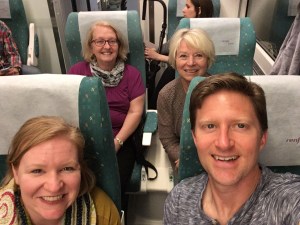
Four of a kind on a train in Spain

Like Mom, my wife’s aunt is also a recent widower and a retiree. They’re both very much involved with their adult children and grandchildren and are active in their communities. My wife’s aunt is a year ahead of my mother’s widowhood, so I think it also helps Mom see the light at the other end of the tunnel. At any rate, having a fourth person in our party means that there are no third wheels. If I want to do a specific activity with just my mother, my wife and her aunt are perfectly happy to go off on their own little adventure. Likewise, this is my valuable time away from work, so my wife and I enjoy sneaking away for a walk on a beach or the a glass of wine in a romantic setting. So it’s nice to not feel guilty about leaving any single person behind. In Spain, the retirees skirted off on their own adventures from time to time, and they really developed a nice bond. So – as I will repeatedly say over the course of this blog – my better half got it right. Thankfully, my wife’s aunt will be joining us again during our trip to Ireland and there will be no third wheels.

Rule 2 – One big thing per day

My wife and I try to stay in decent shape. So when we travel, we’re quite active. It isn’t that uncommon for us to log 40,000 steps or more per day while exploring a new spot. I want to recognize both Mom and my wife’s aunt for their fitness as they age, but these ladies can’t – and probably don’t want to – move around at that pace. So we’re scheduling “one big thing” per day with the option for mini-excursions before or after a main meal. For example, early in our trip to Ireland, we’re going to take a bus tour to the Cliffs of Moher. The term “bus tour” doesn’t exactly elicit the idea of strapping on running shoes and breaking a sweat, but there are several on and off bus stops along the way with roughly 90 minutes to explore the Cliffs on foot. The terrain isn’t paved and it will be somewhat taxing. The six-hour tour will be done by 5 PM and, if my wife and I were on our own, we’d certainly line up something else afterwards. But that’s not the trip we’re on. So we’ll leisurely make our way back to our Airbnb and either eat in or find a quiet spot for dinner to reserve our collective energy for the next day’s one big thing.

Rule 3 – Everyone needs her space

We’re a social bunch, but when away from home for a significant period of time, it can be taxing on the mind and body. When traveling with a group it can be tempting to skimp on space and double up on bedrooms or to have someone sleep on a pullout in a common area. That might work for college age folks, but we’ve each had enough time and life experience to get into our routines. Therefore it’s important that each of us have some personal space. That means renting places with 3 bedrooms (my wife still agrees to room with me) and 2 bathrooms. It’s obviously a bit pricier in places like Europe where space is a premium, but it’s pretty important to give everyone some down time to keep the peace over a two-week long, cross-country trip.

Rule 4 – Find the adventure in things that everyone likes

My wife and I are relatively adventurous. As examples, we rented bikes for our main transportation in Sevilla, Spain; we waltzed out into a chilly Lake Michigan in Traverse City in late September; and I was in my element trail-running the petit balcon in the French Alps near Chamonix. These are not things I will plan to do with my mom. My mom is more comfortable having a quiet moment in a cathedral or sipping coffee in a cafe. That can work out great too. After several years of traveling to Barcelona, we finally took the train to Montserrat on this most recent trip with my mom. We were treated to an up close view of the Black Madonna. In Valencia’s central cathedral, we saw what the Catholic Church claims to be the chalice used by Jesus during the Last Supper.


In both cases, I wasn’t even aware these exalted artifacts existed until we prioritized visiting cathedrals to help suit my mom’s travel tastes. So… Rule 4 was born. Pick an activity that suits everyone and commit to finding the adventure.

In summary

My lovely Mom and me

Both Mom and I have found it to be extremely rewarding to travel together and we’ve shared experiences that will last the rest of our lives. Importantly to me as well, I’ve also shared these experiences with my wife, so we’re able to maximize our vacation time and make memories with loved ones. By following these few simple rules, I’m confident that we can keep going for years to come.


All pictures in this post were taken by Troy Gregory