Reflections of Ireland Part 4: Bloomsday in March

I know I’ve mentioned it in other posts, but I’ll say it again. I am a huge fan of James Joyce. With this year’s major trip going to Ireland, there was simply no way I was going to miss out on having a Joyce / Ulysses experience. Readers of James Joyce will know that June 16, aka Bloomsday, is THE big day for fanatics. For the less initiated, Joyce’s book, Ulysses takes place over the course of this single day in the city of Dublin. I couldn’t be in Dublin in June, so I celebrated my own Bloomsday on Sunday, March 5. While doing my trip research, I was delighted to find not only a James Joyce Centre but also a Ulysses Walking Tour. I have taken several walking tours in the past and they feature in some of my fondest travel memories. After getting my private walking tour set up with David Halpin, Owner and Guide of Dublin Ulysses Tours, my day was set. I was ready to geek out.

The Centre

Before the walking tour, I decided to visit the James Joyce Centre. I’m glad I experienced the Centre before the walking tour. While I want to support the Centre in its efforts to preserve and promote the works of James Joyce, it honestly left a bit to be desired. There are three floors to the Center and the unguided tour is started by climbing the stairs to the top floor to experience the museum on the way back down. The top floor has an interesting Ulysses publication “family tree,” which traces the various Ulysses editions relative to their publishing houses and publication dates. There is also a video that plays three short documentaries about Ulysses. On the second floor, there are several painted portraits from the Joyce family as well as visual schema of each of the chapters of Ulysses. The ground floor has the gift store and a viewing parlor with John Huston’s movie, The Dead playing, but the display lacked any indication as to how it tied to Joyce. So… the James Joyce Centre was good but not great. At €5 per person, I think it’s priced right for the value delivered. If you go, plan for about 1 hour max. The short documentaries on the top floor, which I haven’t found to be available on the internet, take just over a half an hour to watch in total. The rest of the museum will take no more than 30 minutes to walk through.

The Walk

Having wrapped up the time at the museum, it was time for the main event. David and I had arranged via email to meet at The Palace Bar on Fleet Street in the Temple Bar neighborhood. We recognized each other fairly quickly and settled into a back corner over pints of Guiness. Note that David provides customized, personal tours and he’s constantly looking to improve, so if you go (and I highly recommend it regardless of your experience level with Joyce / Ulysses), your experience will likely differ from mine.

The Palace Bar is a time capsule with wood paneled walls, a hardwood bar and a friendly curate to match. While there is a single mounted TV, it was turned off. This is no sports bar. The Palace is an old fashioned pub meant for talking and to add to the ambiance, its walls are adorned with pictures and portraits of the writers and artists who have frequented it over the years. The seats are comfortable and we were free to arrange them as we pleased. The bar was about half full and the other patrons paid us no mind as David pulled out his hefty copy of Ulysses to call out specific quotes and points. During our chat, David and I discussed our own stories and how we came to experience this tremendous author and his seminal work. David is a polite conversationalist and he really takes his time to make a connection. We chatted for nearly an hour. Then we packed up and headed out into the early spring Dublin weather for Bloom-style walk around Dublin.

Immediately outside, David pointed out the gold colored memorials built into the sidewalk commemorating four of the Irish writers who frequented The Palace. He explained their connection to literature and to Joyce. At this point, I had been in and out of The Palace twice and hadn’t seen these gold colored plaques. As I would soon discover, I had been walking over similar commemorative sidewalk features for the previous several days.

After leaving The Palace, David took us down backstreets pointing out Dublin street art dedicated to Irish literature. We stopped by the statues outside of Oliver St. John Gogarty’s Bar and viewed the murals on Bloom’s Hotel.

From there, we walked out to College Green and headed toward Trinity College Dublin. David is full of insights about the roles the characters and buildings played in literary history. I wouldn’t do it justice, so you’ll just have to take the tour. From here, we turned right onto Grafton Street and picked up the trail of Ulysses fictional protagonist, Leopold Bloom. This was my third time to Grafton Street in as many days because it is the main shopping district; however, like those plaques outside The Palace Bar, it was my first time seeing the gold colored Bloom plaques embedded in the pavement. Pictures of three of the plaques follow.

These plaques mark the walk of the fictional Bloom as he traveled the very accurately portrayed streets of Dublin during the course of the day and night of June 16, 1904. Experienced readers will already know from the pictures above that the plaques quote passages from Ulysses at the time in the book when Bloom was at that real life juncture. Off of Grafton, we turned left onto Duke Street, which is where I learned not only that Davy Byrnes still exists in a modern state, but also that there is a Ulysses Rare Book Store. I would later visit the store and purchase one of several vintage copies of Ulysses available for sale. For vintage book lovers, this place is worth the trip just to get a glimpse of the Ulysses first edition that is stored under glass behind the counter. But there are plenty of more accessible vintage books by a wide variety of authors on the shelves that the average wallet can afford.

We then followed Bloom’s footsteps over to the National Library, where David brought Bloom and his arch rival, Blazes Boylan, to life with a quick reading of the corresponding parts of Ulysses. From here, we traveled to a neighborhood hotel for a quick stop and a view of what is perhaps the least known – and by far the best rendering I have seen – memorial to Joyce and Ulysses. David’s narrative perfectly illustrated the quoted text as we made our way around the 360 degree monument. Given that this piece isn’t yet called out on Joyce sight-seeing website lists, I’ll keep this spot concealed and again refer the reader to David’s Dublin Ulysses Tour to catch a glimpse.

From here, we made our way to Sweny’s pharmacy, which is where Bloom fictionally picked up the lemon soap for his wife Molly. Sweny’s is no longer a working pharmacy, IMG_2558but is rather a standing homage to Joyce and societal home to – these are my words – a loose knit group of local Joyce volunteers who are committed to keeping the sights and sounds of his work alive. Inside, David introduced me the volunteer in chief, PJ, who shook my hand and inquired about my surname. After providing him with my four nearest related family names, PJ rattled off a brief and authoritative geographical history of my 4 bloodlines. After that, he sat down and sang me a song in Irish as he strummed along on guitar. And with that act, I’m pretty sure I joined this Joyce “society” in whatever form it exists. My tour with David had concluded, but my evening was far from over.

The Reading

There was almost no question as to whether I was coming along with David to “the reading” after my whirlwind initiation. PJ just looked at me and said, “We’ve had to move the reading across the street to Kennedy’s because we have a good sized group. This is good because we’ll have some pints as we read. Grab a book and let’s go.” So, I did.

“The reading” as the name would suggest, is a group of people sitting around the table each with the same book in hand and each taking his or her turn to read a page. The book was Joyce’s Finnegans Wake, which I had never read.
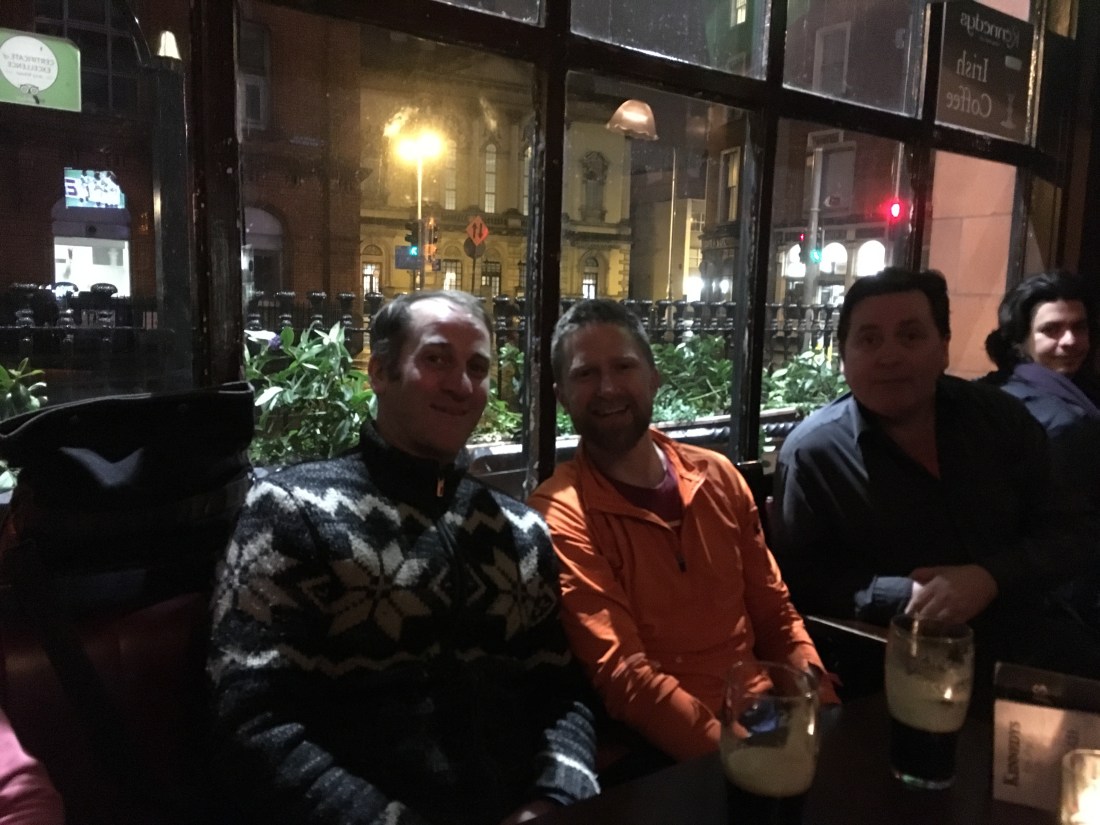
IMG_2559
David Halpin, me, and other “readers”

What I did know about the book is that it took Joyce 18 years to write and that the language was almost entirely Joyce’s own amalgamation of various languages around the world. It has a reputation for being nearly unreadable. There was no time for me to be intimidated. About 4 minutes after I sat down and caught the place in the book, it was my turn to read. It is said of Joyce’s work that one of the best ways to access it is to simply read it aloud. I’m sure I got most of it wrong. Others sounded more authoritative in their readings. However, I’m sure that the pints of Guiness that were flowing helped all of us “just go with it.” With one loop round the table of 9 readers, I settled into the process and had a great time. After several loops and a few pints, PJ signaled that it was time to wrap up the reading and he gathered up the books to take back across to Sweny’s.

As the books closed, the discussions opened. I formally met most everyone around the table and we quickly leapt into topics large and small: gun laws in America; US Presidents Trump, Obama, and a sprinkling of Bill Clinton; Irish social classes and Dublin neighborhood distribution relative to the River Liffey; the movie Pulp Fiction, and on and on. Unfortunately, I had to wrap up the evening and get back to my family. As I made my rounds and said my goodbyes, it was a bittersweet moment. I had immediately connected with a Joycian tribe and after a few delightful hours, it was time to go.

Finding Joyce’s Dublin

Through his works and his correspondences, we know that Joyce was fiercely committed to the human experience. After all, what landed Ulysses on the banned book list in all English speaking countries as soon as it was published is the fact that it is an odyssey of the human body and mind. Joyce wrote about things that – at the time – just couldn’t be written about. My day up until that point had been committed to knowing more of Joyce and the Dublin of his time. I was focused on facts and figures. But as I reflected on the day during my long walk along the Liffey back to my Airbnb, I began to realize that my evening at Kennedy’s Bar, connecting with David, PJ and others who share a common interest as we discussed the politics and issues of our day, was as much taking part in Joyce’s Dublin as anything I have done. This is Dublin City. Constantly renewing while celebrating its rich history. Today’s Dublin is Joyce’s Dublin. To experience it, one needs to find a pub, grab a pint, and start a conversation.

Reflections of Ireland Part 3: The Day Dublin Stood Still

Friday, March 2, 2018. If I were to believe the headlines and talking heads on the news, this day was supposed to be filled with danger as the “killer storm” Emma which gave way to #thebeastfromtheeast settled in on Ireland. And yet somehow, we’ve made it alive. Dublin is our third and final leg of our cross-country tour of Ireland. We had significant plans to see various sights and do a bit of shopping. But… Mother Nature has thrown us a snowball. The snow was predicted to be as deep as 10 inches (25 cm) in Dublin City. By my estimates, we’re right around 4 inches total over 2 days of snowing. For a country that gets roughly 2 inches of snow per year, it is a lot. They’re not equipped with snow plows and such, so they do a little grit-spreading and hope for the best.

Closed for Business, but Open for Craic

All major tourist attractions were closed, as were all public transit systems. Essentially all businesses were closed and very few taxis were operating. This vibrant, mischievous city eerily rolled up its sidewalks for a bit of snow. However, the residents of Dublin were not to be deterred. Being from Ohio, where we get plenty of weather of all types, I happily went out in the weather several times and I encountered loads of people. In fact, at the height of the storm on Friday morning, I set off on a run from Sarsfield Quay (pronounced “key”) along the River Liffey and out to the ocean via Irishtown. The round trip run was 10 miles and took me a little longer because I had to check Google Maps from time to time. Travel Tip: When traveling to a city outside your home country, I highly recommend downloading offline maps of your destination. It will allow you to see where you are and navigate streets without using data. Its a handy replacement to using a physical map. I want to be clear here: when I say “navigate” I’m not saying that it will give you turn by turn directions like navigation, but it does allow you to see your “dot” on the street and you can zoom in on your location to see street names and notable locations. Every time I ventured out, I found people walking their dogs, searching for open grocery stores, or having a bit of craic (Irish term loosely meaning “fun;” pronounced “crack”). I came across people building snow men and several “gangs” of teenage boys itching for a snowball fight.

Snowballs Thrown

I was hit with several snowballs during my travels in the city. I took it for what it was – boys having fun. I noticed that only men who appeared fit enough to defend themselves were targeted, so this wasn’t a situation where kids were out being bullies. As I made my way in the streets, I would catch a glimpse of someone making a snowball and turning away. It was a sure sign that one was coming my way. A couple of times, they’d miss and I’d talk a little trash about their poor marksmanship. Usually, they rose to the challenge and fired a few more my way. Only once was I hit in a malicious way. I was walking past an older teen with grocery bags in both of my hands. I noticed the snowball in his hand and made a mental note that I’d brace for the throw about 15 paces after we pass one another. It didn’t take so long. Right after he passed me, he smashed the snowball into the back of my head. For a second, I considered dropping my bags and retaliating. But I’m sure that’s what he wanted, so I just kept walking without giving him the satisfaction. Not everyone took the same turn-the-other-cheek approach that I did.

Things Heat up in the Cold

On two occasions, I saw the snowball situation escalate. On one occasion several boys pelted a van with snowballs. The driver stopped, words were exchanged, but not much more came of it. On another occasion, a boy threw a snowball over a car – to be clear, it didn’t even hit the car – and the driver pulled over. This was in the midst of “The Beast” and the driver hopped out in only a t-shirt and jeans. He was itching for a fight. Muscle bound and shaved head with a chain connecting his wallet, he got out and gestured at the boys. I couldn’t hear the words, but he clearly wanted a fight. The boys – there must have been 8-10 of them – all stayed out of arms reach and I thought that it was over. Nope. The man made a “That’s what I thought” gesture and started to turn around to get back into his car. And that’s when they hit him with three snowballs at the same time. I was laughing out loud, incredulous. I live in a de-escalated world where this simply doesn’t happen. Furious, the man rounded on the boys and took a few steps in the direction of the snowballs. The boys scattered, but it only lasted a few steps. When the man dind’t get hold of anyone they turned back around and fired off more. I kept thinking that this is going to end in fisticuffs if someone doesn’t layoff. That’s when the girlfriend got out of the car.

Apparently muscle man had a significant other in the vehicle and she was tired of seeing her man pelted with snowballs while not one of the snowball-hurling kids being willing to physically fight him. So she jumps out of the car and into the street while making wild hand gestures and – although I only wish I could hear her – yelling madly at the group of kids. She’s egging them on to either fight her or to hit her with a snowball, which thankfully no one does. I assume at this point if she gets hit with a snowball, muscle man is going to run someone down with his car. This Mexican standoff continues down the road in front of the Guinness factory, and then well beyond our ability to see it with the car moving about 20 yards at a time. Here’s what I know: I didn’t read about it in the papers the following day and I didn’t see a snowball fight-related murder on the news. So I can only assume it all ended peacefully enough.

Slow Down and Have a Laugh

In the end, I think this incident was a perfect microcosm of Dublin. It’s a vibrant city full of young adult things to do but it lacks a bit of maturity. Yes, there is an incredibly rich literary history, but if you look into those authors, few of them were above a bawdy joke or a long night of hard drinking. And that’s just fine by me. I know that I’m certainly guilty of taking myself too seriously from time to time and this mischievous city with its public shutdown and wild snowball fights is just the reminder I needed to sit back, have a drink, and enjoy the ride.

– Sláinte!

Reflections of Ireland Part 2: On the Road to Tralee

If you’d like to connect with a people and their culture, spend a couple of days in the hospital. I know, I know, that sentence didn’t end the way you were thinking. Our trip hasn’t exactly gone the way we thought it would either. On the second half of our bus tour of the Ring of Kerry, my wife started getting sick. By the time I got her back to our Airbnb in Killarney, she was literally green and feverish. After she had a nap and overcame her fever, we consulted WebMD and discovered her symptoms checked all the boxes for an appendicitis. Having never experienced a health problem away from the US, we called her insurance company for some direction. The response was swift and admirably simple: go to the hospital and save your receipts for reimbursement.

On the Road to Tralee

Our stay is in Killarney, which is a lovely little town of about 14,000 residents and no hospital. The closest hospital is about 30 minutes drive into a neighboring town of Tralee. We consulted our Airbnb hosts and they confirmed that Kerry General Hospital in Tralee is the place where they go if needed. So, we packed up and headed out. I was raised in the US so driving a sizable right-side drive, manual transmission vehicle on the left side of the road is a bit disorienting. Luckily, I’ve had a few days practice so I was able to deal with the added stress of driving my wife to the hospital at night on roads I hadn’t seen. However, I’ll readily admit that my knuckles were white from time to time over the half hour drive. Over the next 36 hours, I would make this drive in both directions several times as I made provisional trips to and from the hospital. Travel Tip: Planning to drive in Ireland? On top of allowing yourself some time to orient to the left side of the road before jumping into city traffic, I HIGHLY recommend paying the extra fee for the GPS. It took the guess work out of reading road signs (written in Irish first, English second), navigating countless roundabouts, and helped me keep track of the not-always-noticeable speed limit signs.

Irish Healthcare

In hindsight, I’d have looked up the information before traveling to know what to expect. What I learned in our exhaustive time in waiting room of the Emergency Department is that Irish Healthcare is among the slowest in Europe. My wife was seen promptly for admissions and was seen by the triage nurse within 35 minutes. After a very short interview, she informed us that it would be a 4-5 hour wait before we could see the doctor. It was closer to 6 hours. Having arrived at the hospital at roughly 9 PM, we were able to see the doctor at 2:45 AM. Other than taking blood and urine samples and a basic interview of symptoms, no diagnostic work was done until the next morning. At least she had a bed. After sitting in the aluminum bleachers in the waiting area for hours on end, getting a bit of rest in a hospital gurney helped her feel a little more comfortable. I spent the early morning in minimally padded chair next to her and only nodded off briefly once or twice. Over her 36 hour stay, she had an ultrasound, a CT scan, and several consultations with knowledgeable and caring nurses and doctors. The amenities left a little more to be desired.

Other than during her initial consultation with the doctor, she spent the entire time on a gurney in the hallway because the hospital was over-full, which we’re told is quite routine. I promptly lost my chair when she moved into the hallway and either had to go sit in a waiting room away from her or stand in the hallway near her bed. Perhaps the most frustrating part of the visit was the delivery relative to commitments. For instance, after learning that her ultrasound did not help with the diagnosis at 10 AM, we were told she would have a CT scan by 3 PM. She actually received a CT scan at 5:30 PM and was later told that only emergency CT scans are read after 5. That was when we realized that she’d be spending another night in the hallway. Thankfully she didn’t require surgery and was released the next morning with prescriptions. In the end, I would rate the care received as very good, the amenities as less-than-adequate, and the wait times to be longer than average. Travel Tip: If you need hospital care in Ireland, Americans can expect quality care comparable to what we receive in the US but with significant wait times.

The Human Connection

Spending 36 hours in a hallway gurney along with other patients and their families provides significant opportunities to connect with people. We met, among others, a 12 year old girl who broke both wrists in an elliptical bike accident, an elderly lady who was denied an oxygen tank because she hadn’t demonstrated that she had “given up the fags” (stopped smoking), a retirement-aged mother who personally thanked me for the existence of Bon Jovi, and a nurse who wondered what we thought about President Trump. We also got the chance to sit quietly for a bit and listen to conversations among locals. There is a wonderful, polite rhythm to the Irish conversation. It might go something like this (the reader will have to insert the Irish lilt):

  • Man 1: Alright John?
  • Man 2: Never better. You and the missus?
  • Man 1: Nary a complaint
  • Man 2: Where’s that no good partner of yours?
  • Man 1: Did ye check the canteens and pubs?
  • Man 2: I ‘spect he’ll be shutting ’em down later
  • Man 1: Dontcha know
  • Man 2: Alright, gotta get on with it
  • Man 1: Good luck to ye
  • Man 2: T’anks a million, take care

I mentioned in my last post that Ireland and her people reminded me of my childhood home in Southern Ohio. Never was this more apparent than in the hospital. The spoken and body language communicates so much with so little. There is a wonderful wit and wisdom communicated with a sense of humility in these little exchanges. Briefly, one can let the another know that he feels for him and that “we’re in this together.” My wife and I discussed this at length. We believe this comes with the homogeneity of culture that permeates much of rural Ireland. Because of their shared culture and vernacular, they’re “hyper-communicating,” which is my term for sending paragraphs of dialogue in verbal and non-verbal shorthand. And while our accents are different, this brand of communication is very much a part of Southern Ohio’s Scotch-Irish culture. In fact, we even share several colloquialisms. To illustrate, I was giving one of the nurses a hard time and she didn’t respond, feigning frustration. My wife told her to not take me seriously and I said, “Ah, she knows I’m only just funnin’.” This prompted an almost immediate reply from a third party nurse: “Where did you say you’re from again? Because you’re clearly Irish.”

Welcome Home

I wouldn’t wish an appendicitis on anyone. My wife experienced intense pain and I’m sure she was “this close” to having an appendectomy while in the middle of our vacation. However, the experience – without question – gave us a chance to better connect with our host country. And when you boil it all down, that human connection, that rediscovery of the common thread that binds us all together, is essentially why we travel. In the waiting room, as we were chatting with the mom and her little girl with the broken wrists, an elderly lady overheard us and asked if we were American. We said that we were. She smiled from ear to ear, looked at each one of us and said, “I’m sorry for your trouble, but welcome home.”

Reflections of Ireland (Part 1)

Ireland has been on my bucket list for quite some time. Like many in the US, and like most people from the town in which I hail, I have more than a little Irish heritage. I’ve always wanted to go to Ireland and have a look around. My favorite author, James Joyce, is also famously Irish. Walking around Dublin and seeing the sights of Joyce’s epic Ulysses has been of dream of mine for several years too. Our trip plan is to start in Galway and see the Cliffs of Moher. Then we’ll travel to Killarney and tour – among other things – the Ring of Kerry. Having checked the box on beautiful countryside, we’ll move on to Dublin for several days. I’m a few days into the tour and I wanted to pause for a few reflections.

Ireland feels like home

I’m originally from Southern Ohio. Think, “foothills of the Appalachian Mountains along the banks of the Ohio River.” My part of Ohio is dominated by Scotch-Irish culture that has had time to ferment in a small town environment for a few hundred years since our ancestors predominantly migrated from Ireland. Our people are a heavily accented, slow-paced, kindly folk who are fiercely independent and suspicious of “outsiders” who might be selling solutions to problems that they likely don’t understand. The Southern Ohio landscape is dominated by lovely rolling green pastures, forested hills and plentiful natural water sources that support farming and outdoor activities such as hunting and fishing. I honestly can’t say I was surprised to find a very similar land, culture, and people. Admittedly, I haven’t made it to Dublin yet, but what I have experienced feels like my rural Ohio roots. What I have been struck by is the amazing beauty of the Emerald Isle.

Did I mention that Ireland is Amazingly Beautiful?

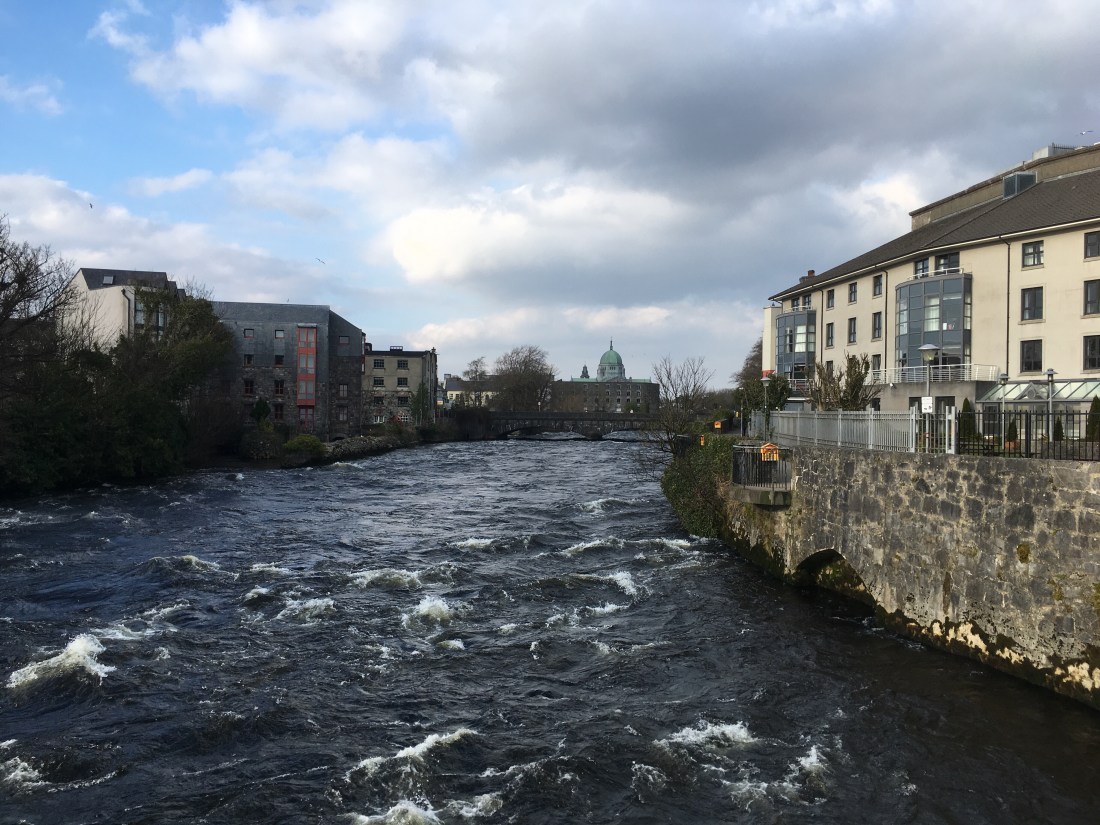
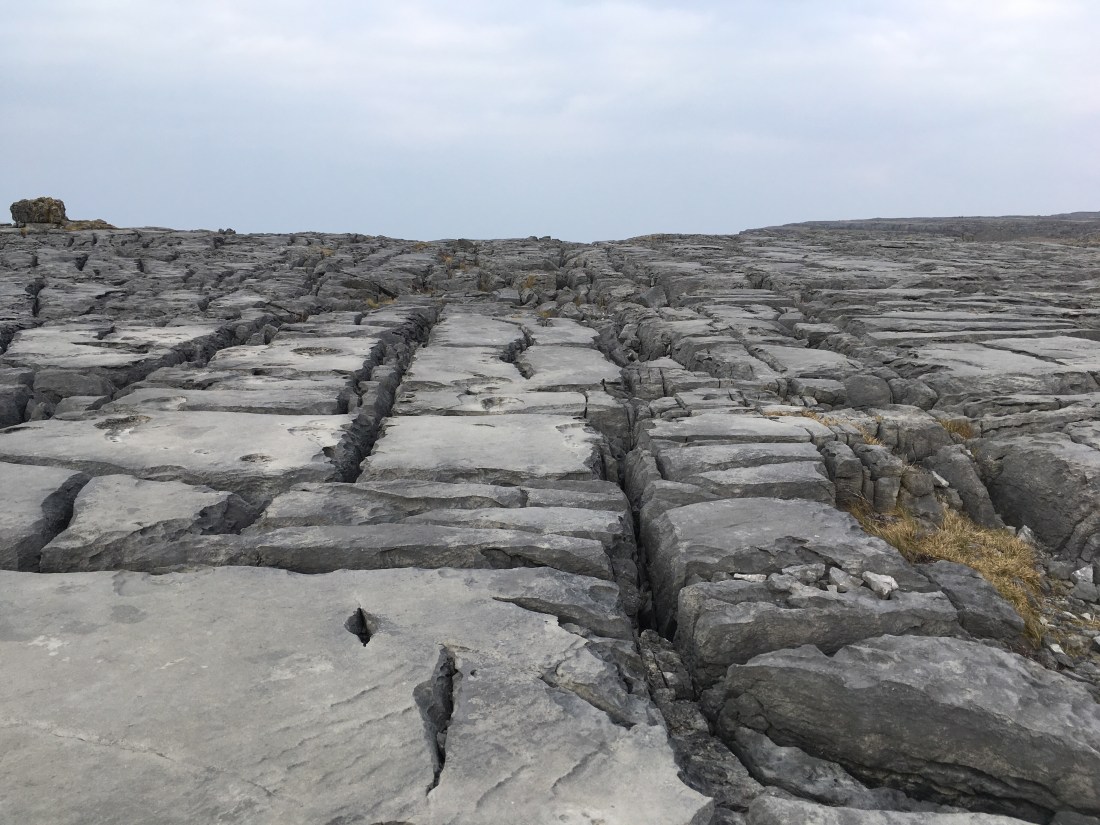
So far, I have driven from Dublin to Galway, taken the Cliffs of Moher tour, driven from Galway to Limerick with a brief stop for lunch and a tour or King John’s Castle, and then on again from Limerick to Killarney. The sights are absolutely a.maz.ing. In just a couple of days, we’ve been able to see (pictured in order) 1. The River Corrib in Galway, 2. The Cliffs of Moher, 3. The rocky coast of the The Burren, 4. King John’s Castle in Limerick, and 5. Muckross Lake in Killarney. I am absolutely enamored with the beauty of this country – and, while Southern Ohio cannot totally compete – the sights are at least reminiscent.

The River Corrib in GalwayThe River Corrib in Galway

The Cliffs of MoherThe Cliffs of Moher

The rocky coast of The Burren

View of the River Shannon from atop King John’s Castle

Sunset over Muckross Lake

Until next time… Sláinte chugat!

Five Benefits from Five Years of Journaling

I first started journaling when I was going through a divorce several years ago. The stresses of separating from my spouse, figuring out finances, and helping the children adjust all while maintaining my focus at work was getting to me. I almost started journaling on a whim. I’m a bit of an introvert and I’m not prone to sharing details with others. So journaling was my way out; my way to organize my thoughts and to “say” the things that I didn’t want to actually verbalize to anyone else. I wrote somewhere around 200 pages over 18 months. When my divorce was complete, I purged the file and later started a new one. My second journal turned 5 years old two weeks ago. I’ve decided to start a new one. The file size was getting unwieldy and five years seems like a good cutover point. Starting anew, I reflected on the journaling process and realized how much I’ve learned from it. While there’s probably more, here are my top five benefits from five years of journaling.

1.) Problem solving

I solve problems for a living. Of course, I could argue that everyone who has a job is essentially being paid to solve problems that customers aren’t willing or able to do themselves. But problem-solving is my specialty. I have an engineering background, several technical certifications, and 20+ years of experience solving fairly sizable problems across various industries. With these credentials, one might think that I could solve just about any problem in my sleep. That would be wrong. While it certainly is my forte, sometimes I get stuck. I find that journaling is my unlocking mechanism. The free form of journaling helps me describe a problem from multiple angles or to refine what it is and what it isn’t. I find that spending time writing about a problem not only helps me find breakthrough solutions, but it also stops the swirling in my head. I also use it for household problem-solving. For instance, there was a particularly nasty head and chest cold going through our house from season to season and journaling about it over time helped me figure out how to 1.) avoid getting it and 2.) speed the recovery time from more than 3 weeks to about 5 days. 

2.) Procrastination buster

I’m not one for procrastinating. I’ve always been internally motivated, so when I recognize that something needs to be done, I generally get going. Therefore when I am actually procrastinating on something, I know it’s a special cause. I might not like what needs to be done and I might be waiting on a better solution. Or, it might be that I have too much to do and – if I’m honest – I’m too busy feeling sorry for myself that I won’t pick a direction and move. Bring on journaling! Writing about these situations helps me to be honest with myself about my lack of movement. It really might be that I’m overwhelmed. I’ve often heard the quote, “Sometimes when you don’t know what to do, the best thing to do is nothing.” (Unknown attribution) I wouldn’t say that I do nothing. But I certainly have learned that sitting down to the keyboard, which was no where on the list of things to do, helps me prioritize the work in front of me. When I’m procrastinating out of a sense of being overwhelmed, journaling is exactly what I need. If I’m just hung up on the task at hand or feeling sorry for myself, sometimes I go ahead and have a good complaint session. I write down all the crap that’s annoying me at the time. The act of reading it after I’ve written it helps me see how petty I’m being. Recognizing my pettiness then causes me to shift into gratitude for everything that’s great in my life. And gratitude is extremely motivating. The point is that while I don’t procrastinate often, it can be caused by a number of different factors, and writing helps me get to the bottom of it and get moving.

3.) Better communicator

Have I mentioned that I’m an introvert? One of the key characteristics of an introvert is that we have far, far more thoughts than what comes out of our mouths. A lot of times, I’m just not ready to speak. I might have 4 thoughts on the same topic and if I start speaking without organizing them, I’ll probably confuse myself, never mind the poor listener. Journaling helps me get my thoughts out of my swirling mind. When a topic is particularly complex, the only way to sort it out is to pick up the journal and simply start writing. I may write in circles – making the same point repeatedly with only slightly different angles. But writing it down helps me sort out my thoughts so that I can communicate in a cogent manner. 

4.) Emotional Intelligence

Emotional intelligence is the ability to recognize and exercise control over your emotions, which in turn helps you connect with others. Journaling has helped me in strides on this front by following a simple guide that I learned in college. I took a course on Personal Transformation, which was amazing. Among other techniques, I learned to break down interpretations of an event. I’ll use an example to illustrate. Let’s say I’m running late to work and on the commute, someone cuts me off in traffic. My brain might jump to a conclusion like, “She cut me off just to be a jerk because she could see I’m in a hurry.” In this class, we learned to separate what happened from our interpretations. What actually happened? A lady merged into traffic in front of me, maybe cutting it a little too close given local standards for traffic spacing. When I interpreted what happened, I assigned meaning to the event. She meant harm. She meant to do what she did to prove a point. When I journal about this event, I might rant and rave about it for a few sentences, but then I use the “what happened and what did I interpret” method to break it down. After journaling, I might realize that I created the tight space with my rushed driving. She might have thought she had ample time to pull into traffic had I been going with the flow of normal traffic. Or, maybe she was also in a hurry because she was on the way to the hospital to spend time with an ill child. I really can’t know what was going on with her and I may have had some input in the event. Over time, this practice has become like a muscle that I flex through journaling so that I’m able to process faster in real time, thus giving me more Emotional Intelligence.

5.) Mindfulness Step 1

I didn’t realize it, but when I started journaling on and off about 8 years ago during my divorce, I took my first steps toward a path of mindfulness. dictionary.com defines mindfulness as “a mental state achieved by focusing one’s awareness on the present moment, while calmly acknowledging and accepting one’s feelings, thoughts, and bodily sensations, used as a therapeutic technique.” I originally started journaling to sort out my thoughts and feelings during my divorce. I needed to address my concerns about the kids and money and the car and the laundry and the bills and the… you get the point. Through journaling, I was able to feel like I was doing something about my concerns. I could write them out to their logical conclusion and see that things would somehow be okay. I was learning to be present. It was a form of meditation for me. Having logged 300 pages in the last five years, I can easily say that journaling was a HUGE first step in my mindfulness journey. 

Getting Started

If these five benefits sound pretty awesome, there’s not really too much to getting started. You might start with a pen and paper. I personally use Pages on Apple products and simply password protect the file to help ensure that it doesn’t get opened or edited by others with whom I share devices. You can do the same with Google Docs and Microsoft products. Whatever you do, stick with it. You might not see the benefits on your first entry, but over time you’ll have your own top five list of benefits.


Traveling with a Parent

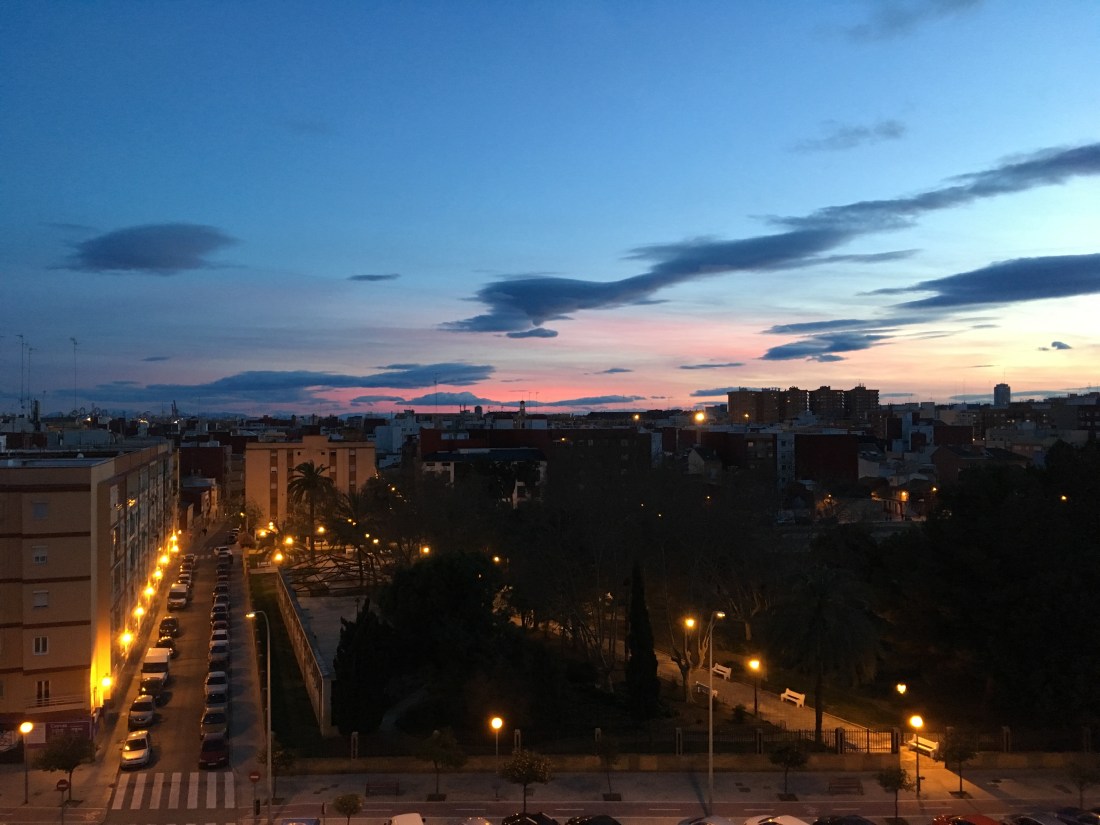
Sunset over Valencia

Traveling can be a great way to share fun and exciting experiences with a parent by following a few simple rules.

The Backstory

I must get my adventurous spirit from my mother. She had always wanted to travel with Dad, but his declining health after retirement made it impossible. Sadly, he passed away about 18 months ago. After allowing herself ample time to grieve his passing and after getting things settled, I’m grateful that she accepted my invitation to go to Spain. So about 8 months ago, my wife and I took Mom to our adopted home away from home, Barcelona and added on a brief stay in Valencia. While in Spain during a casual conversation at dinner, Mom listed off her dream travel destinations: England, Scotland, Ireland, Australia, and New Zealand. I lovingly pointed out that all of her dream destinations have the English language in common, to which she replied, “Oh, I didn’t even think about it, but I guess that’s true!” Oh Mom, I love you. Anyway, I got the message loud and clear. This year we’re headed to Ireland.

Planning the Trip

There were definitely some lessons learned from the trip to Spain. Most of it went very well. But through a little trial and error, I settled on some general rules for traveling with a parent.

Rule 1 – No third wheels

My wife and I love to travel, but taking others along with us can be tricky. I credit my wife with the stroke of genius to invite her “aunt” (actually a very close second cousin) to go with us on the first trip to Spain and now again to Ireland. My mom and her aunt have a fair amount in common.

IMG_0905
Four of a kind on a train in Spain

Like Mom, my wife’s aunt is also a recent widower and a retiree. They’re both very much involved with their adult children and grandchildren and are active in their communities. My wife’s aunt is a year ahead of my mother’s widowhood, so I think it also helps Mom see the light at the other end of the tunnel. At any rate, having a fourth person in our party means that there are no third wheels. If I want to do a specific activity with just my mother, my wife and her aunt are perfectly happy to go off on their own little adventure. Likewise, this is my valuable time away from work, so my wife and I enjoy sneaking away for a walk on a beach or the a glass of wine in a romantic setting. So it’s nice to not feel guilty about leaving any single person behind. In Spain, the retirees skirted off on their own adventures from time to time, and they really developed a nice bond. So – as I will repeatedly say over the course of this blog – my better half got it right. Thankfully, my wife’s aunt will be joining us again during our trip to Ireland and there will be no third wheels.

Rule 2 – One big thing per day

My wife and I try to stay in decent shape. So when we travel, we’re quite active. It isn’t that uncommon for us to log 40,000 steps or more per day while exploring a new spot. I want to recognize both Mom and my wife’s aunt for their fitness as they age, but these ladies can’t – and probably don’t want to – move around at that pace. So we’re scheduling “one big thing” per day with the option for mini-excursions before or after a main meal. For example, early in our trip to Ireland, we’re going to take a bus tour to the Cliffs of Moher. The term “bus tour” doesn’t exactly elicit the idea of strapping on running shoes and breaking a sweat, but there are several on and off bus stops along the way with roughly 90 minutes to explore the Cliffs on foot. The terrain isn’t paved and it will be somewhat taxing. The six-hour tour will be done by 5 PM and, if my wife and I were on our own, we’d certainly line up something else afterwards. But that’s not the trip we’re on. So we’ll leisurely make our way back to our Airbnb and either eat in or find a quiet spot for dinner to reserve our collective energy for the next day’s one big thing.

Rule 3 – Everyone needs her space

We’re a social bunch, but when away from home for a significant period of time, it can be taxing on the mind and body. When traveling with a group it can be tempting to skimp on space and double up on bedrooms or to have someone sleep on a pullout in a common area. That might work for college age folks, but we’ve each had enough time and life experience to get into our routines. Therefore it’s important that each of us have some personal space. That means renting places with 3 bedrooms (my wife still agrees to room with me) and 2 bathrooms. It’s obviously a bit pricier in places like Europe where space is a premium, but it’s pretty important to give everyone some down time to keep the peace over a two-week long, cross-country trip.

Rule 4 – Find the adventure in things that everyone likes

My wife and I are relatively adventurous. As examples, we rented bikes for our main transportation in Sevilla, Spain; we waltzed out into a chilly Lake Michigan in Traverse City in late September; and I was in my element trail-running the petit balcon in the French Alps near Chamonix. These are not things I will plan to do with my mom. My mom is more comfortable having a quiet moment in a cathedral or sipping coffee in a cafe. That can work out great too. After several years of traveling to Barcelona, we finally took the train to Montserrat on this most recent trip with my mom. We were treated to an up close view of the Black Madonna. In Valencia’s central cathedral, we saw what the Catholic Church claims to be the chalice used by Jesus during the Last Supper.


In both cases, I wasn’t even aware these exalted artifacts existed until we prioritized visiting cathedrals to help suit my mom’s travel tastes. So… Rule 4 was born. Pick an activity that suits everyone and commit to finding the adventure.

In summary

My lovely Mom and me

Both Mom and I have found it to be extremely rewarding to travel together and we’ve shared experiences that will last the rest of our lives. Importantly to me as well, I’ve also shared these experiences with my wife, so we’re able to maximize our vacation time and make memories with loved ones. By following these few simple rules, I’m confident that we can keep going for years to come.


All pictures in this post were taken by Troy Gregory

Stressed? Try to Find the Long View

Situation

Let’s say I sell cars for a living (I don’t but the illustration will serve the purpose). Instead of selling a whole range of cars, I sell one car; a not-so-sexy little number that will safely and reliably get you from point A to point B. It also has a surprisingly low cost once we factor in maintenance and gas mileage. Now let’s say that another model that was clearly designed to compete with mine has popped up on the market. It has a lower initial cost, but overall cost of ownership makes it much more expensive after just a few months. Over the past two weeks, I’ve had two major buyers who were interested in buying my car for their fleet go the other way. I’m just coming off a strong growth year with my little car, so both times I entered the meeting with the buyer confident that I’d close the deal. Both times I was unceremoniously informed that the buyer was picking the other model. I was dejected.

Within a day of the second rejection, I attended a previously scheduled conference in which my national manager gave a business update. This update featured, among other things, the successes of my little car and me as the last year recently closed out. The content had been put together before these two recent rejections. While my car and I were being touted in the meeting, I was still licking my wounds from the two fresh rejections. During the business update, I felt like a fraud who would soon be discovered. My stomach turned, my blood pressure was noticeably up, and I slinked down in my chair. I didn’t want any of this good attention while I was falling flat. Most of all, I wanted my national manager to stop saying good things about me and my little car. I kept thinking, “If she only knew.” During the update meeting, we run a visible comment board and I started to become hyper-aware that the positive comments had dried up as the national manager was highlighting my results. “They know,” I thought.

Analysis

This is how our brains work. We go on a good run and we’re on top of the world. But, have a couple of set-backs in quick succession, and all of a sudden the world is collapsing around us. My wife is pursuing a Master’s degree in Psychology and she tells me that our brains have developed a somewhat-controlled paranoia over many thousands of years to keep us alive. For example, a rustling bush might not have meant a large predator was about to make a meal out of them, but if our ancestors had always calmly assumed the rustling was “just the wind,” our species probably wouldn’t have made it. In other words, we’re essentially pre-wired to jump to bad conclusions.

Reality

The reality of the situation is…

  • My little car and I did have a great year last year and I wasn’t a fraud
  • Yes, two potentially significant customers DID reject my little car for their needs, but the problem isn’t permanent
  • In fact, the clients may find that the cars they went with don’t meet their needs and they could change back to mine fairly quickly
  • Even if they don’t, there will be other buyers for my little car
  • These set backs do NOTmean the end of me or my little car
  • And finally, the kudos in the comment board had slowed up after the individual recognitions 10 minutes before my car was being presented – so it wasn’t because people were “on to me”

Using the long view to overcome a stressful moment

When I was young, if something bad would happen, my grandfather would say, “You’ll never know it in a hundred years” and then he’d have a chuckle. At the time I thought he was just old and insensitive. Of course I wouldn’t know it in a hundred years – I’ll be dead by then! But he was on to something. He was using the long view and a touch of humor to offer me an alternative perspective. This situation really isn’t that bad. When events we immediately perceive to be negative occur, our minds race to what this could mean. We then quickly begin grieving the situation and piling on “evidence” of further doom. But if we’re able to slow down for a mindful moment and consider the reality of the situation in context with the long view, many times we’ll see that things aren’t so bad. This in turn, frees up our mental resources to begin working on what we can do about the situation.

What I Learned From a Year of Going Vegan*

Before getting started, I want to explain the asterisk on the word “Vegan” in the title. In conversation, I normally avoid calling myself or my diet vegan because A.) of the politics associated with the word and B.) I’m not 100% perfect in eating absolutely zero food products derived from animals. With regards to the politics, I’m no extremist and I want to avoid being seen as one. With regards to my vegan imperfections, I’m respectful of the people around me. My wife likes to go on date nights (I’m lucky) and if my meat-free menu selection was cooked with butter or if the wait staff forgot to leave the goat cheese off of my salad, I eat it without tipping over any tables in a fit of rage. Having said that, I estimate that more than 95% of the food I eat is completely plant-based. Not bad for a guy living in a mid-sized city in the Midwest.

How I got here

In short, this started as an experiment. I like to run, and like many runner-types in America, I read Christopher McDougall’s super-entertaining Born to Run. In it, I learned about Scott Jurek and later found out that he had his own book titled Eat and Run. After reading Jurek’s inspiring book, I decided to give the plant-based diet a whirl. Over the years, I’ve tried various diets to see what worked for me and what didn’t. And when I say “tried,” I mean “followed at ~95% rigidity for 3-6 months.” My wife indulges me by figuratively patting me on the head with a reassuring “OK baby.” Again, I’m lucky. So… I started with week one in October 2016. After digging into the topic for a bit, I also discovered Rich Roll, whose excellent podcast and other offerings have kept me going. But that is a tale for another day.

Lesson 1: I rarely missed meat

As I mentioned above, I live in the meat-and-potatoes Midwest of the United States. I was raised on meat and potatoes as was essentially everyone around me. So the first question I get usually when discussing my shift to a plant-based diet is, “How can you live without meat?” In my youth, I was a full-fledged carnivore, so I thoroughly understand this question. I used to muse that if one day because of poor health I had to go without meat, I’d drive off a cliff. I wasn’t serious of course, but I will readily admit that there is a satisfaction that comes with chewing on the texture of meat and the fullness that comes from a hearty meal that includes beef or chicken or salmon or… So, you’re getting the picture, I’m not really a good *Vegan* with a capital V. Now for the interesting part, I have rarely missed meat since making the switch.

Maybe I had enough meat in my 40+ carnivorous years preceding. But once I made the switch, there are very few times that I can remember where I really wanted meat. It was more than a year ago the last time I got the urge of the carnivore. It was a cold January day and my body fat was in the single digits from the plant-based diet and lots of running. I distinctly remember walking out of the grocery store and getting blasted by a cold wind out of the North. I was probably hangry because it was just past lunchtime and I hadn’t eaten yet. Immediately following the arctic blast, I remember angrily thinking, “The only thing that is going to solve this is an entire pot of beef stew.” I did not have the pot of beef stew. I have since found plenty of vegetable stew and other recipes that provide the necessary heartiness to overcome the polar vortexes that we experience in Ohio. While individual tastes and preferences abound, I find that cauliflower in buffalo sauce makes great taco filler, Jackfruit in a barbecue sauce replaces pulled pork or chicken, and adding a few cashews or oyster mushrooms to a breakfast burrito filled with onions and peppers gives me the hearty textures that I want in my food.

Lesson 2: It is difficult to be a foodie in a mid-sized Midwestern city

Quite simply, there aren’t a lot of vegan restaurants or places with distinctly vegan options on the menu in Columbus, Ohio. I have found a couple of places that offer tasty options, but they’re generally a bit young and hip for my tastes. I like to sit down with my wife to catch up on the busy week and we find that we can’t do that very well over the din of Indy music, clinking beer glasses, and blaring TVs. So instead of being a “foodie,” which I’m defining here as one who keeps up with the latest food offerings at many trendy restaurants, I’ve turned into a cook. Recipes abound on the internet, and I got off to a great start by watching a few YouTubers, The Happy Pear being my favorite. I prepare the vast majority of our meals at home and the spill over benefit that I’ve learned is that it makes me happy. I know it sounds a bit woo woo, but I have a real connection with the food that I’m now eating. There is something very uplifting about tucking into a meal that I’ve just prepared.

Lesson 3: I have had no problem with endurance sports

As mentioned previously, I’m both a runner and fond of trying new things, diets included. I had previously tried the Paleo diet. I found it both tasty and effective as a weight-loss tool. Admittedly, I’ve never been a big guy, but I tend to carry 10-15 lbs of extra weight in spite of a fairly active lifestyle. I like to blame my 45-50 hour a week desk job and the occasional adult beverage. I lost all of the extra pooch around my mid-section with the Paleo diet, but I ran into a couple of other problems: 1.) I found that I had trouble sleeping and 2.) I couldn’t run more than 4 miles without my legs locking up. My muscles would just give out. Not really cramping, just more like them saying “Nope, we’re done” and then going out on strike. Since going plant-based, I again lost my mid-section pooch but had no trouble training for, and running four marathons over the course of one year.

I do want to say that in the very beginning of my plant-based adventure I was eating very little carbs and fats. While I could still run and run (~60 miles per week) with my super-trim phsysique, I had a short bout with insomnia and a tired libido. After about a week, I figured out that all I had to do was eat more legumes, nuts, and avocados, which brought back just a little body fat (still in the single digits) and a happy bedroom. In fact, after a year of eating a plant-based diet, my most recent health screening resulted in the best numbers I’ve turned in since I was in my 20s.

Lesson 4: My body’s response to fruit changed significantly for the better

This one is fascinating to me. I don’t know the science behind it, but at this point I don’t care. In years past when I was not at all careful with my diet, I had an interesting sugar spike response to say, eating an apple. It was so noticeable that over time I eventually steered clear of many fruits to avoid the rush and crash. After the first 2-3 months of eating a plant-based diet, I started to notice a significant difference. I can now eat an apple or an orange with absolutely no jitters or crash. These days, I carry two or three pieces of fruit with me per day and I eat them as snacks instead of chips or even nuts. I feel a moderate boost of energy with no side effects. So, I’m sure someone can tell me the science behind it, but I’m now looking at fruit much more favorably these days and I quite enjoy it.

Lesson 5: B12 makes me happy

It’s fairly well documented that people who eat a plant-based diet can become vitamin B12 deficient. Meat eaters get B12 from meat and – while I’m not expert on this – our purified water sources generally prevent us non-meat eaters from getting B12 from “nature.” So, people who eat a plant-based diet essentially need to supplement. Here’s the cool thing: taking a B12 supplement once a week is like a blast of sunshine, a cool breeze, and a group of non-allergenic puppies excitedly running around your feet – all at once. Seriously, this stuff is like happy pills. As with all good things, too much can be problematic. We don’t need a lot of B12 to prevent deficiency (think, teeny-tiny micrograms) so B12 is not your caffeine replacement. This is especially true since recent studies have linked high doses of B12 with increased risks of lung cancer – notably in men who currently or have smoked in the past.

Let’s wrap this thing up in a grape leaf

In conclusion, I’m an imperfect vegan and happily so. My plant-based diet has fueled me through 4 marathons in one year and has provided me with clean-burning inexpensive food that gets me through my work days behind the desk. I have found it easy to maintain a healthy weight even when I take a break from running. What started as the latest in a long line of dietary experiments has turned into a rewarding and highly maintainable lifestyle. 


Troy works and lives in Columbus, Ohio with his better half and their blended family of 6. He runs, reads, writes, cooks, travels, plays soccer, and has a fledgling mindfulness practice when he gets the chance. The picture featured is Troy’s not-so-world-famous homemade veggie paella.

From Humbug to Hooray in Less than 30 Minutes

It has been a tough week. I have felt “off” for most of the week with interrupted sleep, too many personal tasks, not enough working out, and insufficient fresh fruits and veggies. By this morning, I was a grump. I was doing my best to hide it, but I was not a happy camper. 

At work, I’m a manager and I was heading into my team’s Friday morning huddle. “Huddles” are where we get together as a group and bring everyone up to speed on our individual work. I lead the conversation, which helps set the tone for the day. We had a rotational analyst whose last day was today so we had a few extra people around the table to wish him well in his next adventure. We also have a tradition on Fridays. The idea is to have a discussion prompt that as we give our updates, each person answers. These tend to be icebreaker style questions to get people talking for the purpose of team-building. Something like, “If you could pick any single superpower other than immortality or endless wealth, what would it be?” Did I mention that I was grumpy? I was in no mood to even participate in this conversation let alone lead it. That’s when an interesting thing happened.

I admitted that I didn’t have a prompt for today’s discussion and asked the team to generate one. After a couple of miscues, we settled on, “How have you changed in the past 5 years?” I asked someone at the far end of the line away from me to go first. I had hoped that we’d run out of time before getting to me. As we worked our way around the table, people told stories of graduating college and finding new friends, of watching kids grow up and needing to adjust parenting style, of seeing parents grow old and feeble, and of harrowing tales of having a child recover from a tumor. Some people got married, some people were once rock stars, some had children of their own, and some went on amazing trips to volunteer abroad. As I scanned the room, I was floored by the smiles on people faces. One young lady exclaimed, “We’re a bunch of badasses!” We laughed out loud. 

In the end, there was just enough time for me. With my mood lifting, I explained that I had gotten married a second time (very happily), I changed industries and no longer had to travel to marginally secure Mexican border towns, I had a child start college and another start high school while I maintained great relationships with both, and that I ran my first marathon and then kept on going for 3 more on the year (which prompted good natured calls of Forrest Gump). We all filed out of that meeting room with smiles on our faces. Two of the guests from other work teams said that they were going to use the Friday discussion prompts for their teams. Before I got back to my desk, a co-worker looked at me in earnest and said, “Really good meeting, thanks.”

The truth is that today, it wasn’t really my meeting at all. If given the choice, I wouldn’t have held it. I didn’t come up with the discussion prompt and I talked very little until the last 2 minutes. Prior to the meeting, I had tried to break through my grumpiness a couple of times with short meditations, listening to music, and even going for a brisk walk. Nothing helped. I had resolved to quietly grumble my way through my day and then sweat it out this weekend on a long run. Instead, I got support without asking for it. I was lifted by others’ stories of accomplishment and gratitude, which helped me practice my own. The mood carried me through a very productive day and into the evening.

I’m still a novice in my mindfulness practice. But I’m learning. I tend to be problem-solver and most of the time I can work things out for myself. Today, I learned first-hand about the power of having a support group – even when the group was none-the-wiser that they are supporting you. Sometimes, I just gotta get out of my own way.

A New Beginning

I originally started Quixote Goes as a travel blog. It was going to be a space where I wrote about planning, experiencing, and reflecting on travel. But shortly after I started it, my Dad got sick and went into the hospital for intensive care. After a 5-week battle with illness, he passed away. It wasn’t a total shock. His health hadn’t been the greatest over the past years. However, losing your father will cause you to reevaluate what’s important. At that time, keeping up a travel blog wasn’t near the top of the list.
More than a year has passed and I’ve been getting the motivation to write again. However, I’ve decided to expand the focus of Quixote Goes beyond travel. Since my Dad’s passing, I’ve become a different person. I still love to travel, but there’s more. In 2017, I ran the marathon that I contemplated in 2016 and then some. I also switched to a whole foods, plant-based diet. In addition, I began actively pursuing a mindfulness practice. As a result of these endeavors, I’ll open the topic list of this blog accordingly.


Over the past several weeks, I reflected on the name Quixote Goes. Does it still fit with this expanded subject matter list? Does the subject matter list even go together? How many Ohio-based, 40-something, office-working, imperfectly vegan, marathon running, fledgling zen buddhists who like to travel are there in the world, anyway? In the end, I decided to simply go with it. And like my beloved character Don Quixote, I’ll just have to see where the adventure goes.